Stella was convinced. She was convinced she would be dying alone, likely surrounded by cats and collectible tea cups. She was convinced of many things, her mind always willing to quickly believe whatever whims might enter it – perhaps she had meningitis or her friends were upset with her or she would fail out of her master’s or maybe she was secretly a bad person and no one had noticed yet. Sometimes she had so many thoughts at once that they seemed to merge together into one foreboding hum. Never mind all that, she tried to tell herself. It was dark out, and as you know, darkness breeds nasty feelings best left alone. It was one of those evenings where, rather than go sit at home and accept that the day was over, Stella preferred to stay out in the world a bit longer. The white snow-covered ground reflected off the clouds, and the sky loomed close overhead, as if pressing all the people in the little city below between two pages of a book. The sun was beginning its descent, and lights were coming on in houses, each window a frame for a little storybook life. To a stranger glancing in the window, each one was a beautiful tableau, a painting – someone framed in lamplight, gazing into another room, mid-conversation, eternally suspended in that moment. Even though it was as candid as could be, Stella had always thought that it was as if an artist had handed them a prop and told them how to angle their head, their neck, their shoulders. They would always and forever be remembered in that pose. Stella trundled down the slippery sidewalk, gazing in windows, selecting bits and pieces she wanted to paste into her life. The grandfather clock in the house on the corner, a lovely painting of a sailboat in a stormy sea peaking out from behind a curtain, the way the couple in the first-floor apartment down the street smiled at each other. Eventually, the wind got to be too cold, and her fingers got too numb, and she reluctantly climbed the steps to her peeling, faded front door.
It had been an extraordinarily disenchanting day in the lab, and Stella wasn’t quite sure why she’d even gone in. It had become quickly apparent as she embarked on her academic career that a massive amount of science was just sitting around. Days of frenzied testing and collecting, followed by failure, followed by crying in the incubator room, followed by hours spent sitting in front of a notebook page titled “what went wrong?” Stella had been slumped in her squeaky swivel chair in her windowless office, staring down her mistakes in bullet point format, when she realized she missed whimsical things. She missed the magic of the world. She missed sunlight and wind on her face. Science is creativity, she had thought, staring into the pinched face of the PhD student she shared a cubicle with; it is the need to ask the strangest questions in order to understand and be better understood. It is philosophy at its purest, and yet science has a marvelous way of taking curious people, people filled with wonder, and hope, and cutting out all the specialness. When Stella had been young, science had been watching a ladybug ascend a blade of grass, or the smell of sundrenched fur as she pressed her face into her cat’s belly. Then science had been National Geographic specials, and books and magazines filled with glossy photos of far-off lands and strange creatures. Then it had been the smell of new notebooks and carefully drawn sketches of cells and organs and explanations for how all life had come to be. It had been Jane Goodall and Charles Darwin and Marie Curie. She got to college and science had become her first lecture hall, the beginning of something, knowledge at her fingertips, anything she had ever wanted to know spread before her. She would save the world and all the creatures in it, as she embarked on grand adventures and solved great mysteries that could be tied up in neat little bows. In science, everything had an answer, it was a puzzle, and each piece had its place. Now she stared at a spreadsheet. The numbers were all wrong and her code wasn’t running and she wasn’t even particularly interested in what it might spit out if it did. It didn’t matter because it would eventually be dryly summarized into a mediocre publication that no one would read, and the only takeaway would be that we should probably do a bit more research because these numbers might possibly mean something, but we can’t really say for sure. It wasn’t a topic she really cared about, but there had been funding in this lab, and she had been accepted to the program, and her supervisor had the resources for this project, and so she had reluctantly set out to pursue knowledge for the sake of knowledge, and maybe a degree. It had been a truly depressing day.
Stella sunk into the couch, attempting to push the dark and nasty thoughts out of her mind as whatever reality TV show was new reflected off the dinner plate balanced on her knees. She heard people laughing and chattering on the sidewalk outside her window, but when she glanced over, all she could see was her reflection. She seemed to blur at the edges, her eyes were shadowy sockets, her face looked flat and gaunt and pale, and the couple on the TV behind her were engaging in some tongue-based elimination challenge. She dragged one of the many throw blankets strewn across the couch from its spot wedged between the cushions and bunched it around her feet. That was the thing about student houses – everyone comes in with the oddest assortment of items. There were five throw blankets, but two pans between six people, and one of the pans was absolutely no good. Several of her roommates had already owned toasters upon moving in, so they lay in odd corners of the kitchen, none of them working quite right. There was only one knife that could cut vegetables worth a damn, and it was always left dirty in the sink. Perhaps they were all getting a little too old to be living like this.
Roommates filtered in and out with meals that could be generously defined as dinner, quips about their days, risque descriptions of their lab crushes, and reminders to pull the garbage bins out to the curb. Stella lost herself for a little while to the human bustle, letting the voices and laughter wash over her, but several hours later, lying in bed propped up next to her laptop, she found herself thinking dark thoughts again. Thoughts like “God, I am in so much pain. It hurts so, so much. I wish a doctor would ask me where it hurts and when I pointed, they would cut me open and patch me together and then sew me up in a nice straight line.” Alarming thoughts. Unsettling thoughts. Phone and computer and music playing all simultaneously were not enough to drown out the buzz. The ceiling seemed to be sliding down the walls towards her. The bed felt too soft. She could hear the radiator hissing, and the lights buzzing, and she felt as if there were too many garments and blankets touching her, and also nowhere near enough. She needed them to press her back into the mattress, to anchor her. It was as if a precipice lay in front of her, a dark chasm of absolutely nothing. Tomorrow, she would get up and shimmy down the icy paths to her bunker of an office to solve a problem that would get her a degree that she was beginning to come to the conclusion she didn’t even want. She realized she was made of wishes, and none of them were for the future she had carved out for herself. There was a static feeling behind her sternum, where her heart should have been. She was not alive, she realized. She must have died, days ago, weeks ago, or so far back she couldn’t remember. She had been going through the motions; she had been playing pretend. Pretending to smile, pretending to care, pretending to be ambitious and driven.
So she left, like the ghost she was.
There was evidence she might have existed – an indentation on the couch, silverware left dirty in the sink, slush from her snow-caked sneakers on the doormat. But these were the leavings of a shade, a marionette, a pretend girl with pretend dreams. And so, she slunk into the darkness.
If the girl who had once been Stella could feel things, she would have felt that the bus represented a kind of liminal space. A sort of infinite in between. Fluorescent lighting coating all the passengers from above with a harsh glow. Every head turned down. Windows reflecting the images of grimy upholstery and swaying people while dark night rushed by outside. No world existed beyond the bus, and the smell of wet coats thawing under weak heaters and recycled air. The girl tucked herself into a back corner, her feet propped on the seat in front of her, her head on her knees. The knees felt foreign, shockingly human. “These are the knees that belong to the body of the real girl that I haunt”, she would have thought, if she could think things. But alas, she could not. And so, she was shuttled off into darkness so dark that it was like a thick cloud, a tunnel with no end, space just enough for them to slide away.
The girl rode the bus for so long that she began to forget. She forgot where she had been coming from, and forgot where she had meant to go. The others on the bus murmured and shifted and creaked like some sort of asphodelian congregation, linked together by their unending journey to nowhere. She began to creak and sway with them. She settled deep, deep within the girl that had once been Stella. Some pocket universe in her mind, a dank little cave in the pit of whatever consciousness remained.
There was a sudden shudder. The bus had stopped. It was empty now, as if all the other passengers had faded away.
“End of the line,” called the bus driver.
The girl didn’t move. She couldn’t, for she had no body. It had dissolved completely, somewhere between here and there.
“End of the line! You have to get off, lady, I’m going home.”
Even ghosts adhere to social etiquette, and it’s very rude to keep someone from clocking out, so the girl gathered her wispy self and floated to the front of the bus. She cast a mournful look over her shoulder at the driver, who was most terrifyingly human. He looked like he experienced hunger and passion and joy and sadness. It was enough to send her slithering out the door.
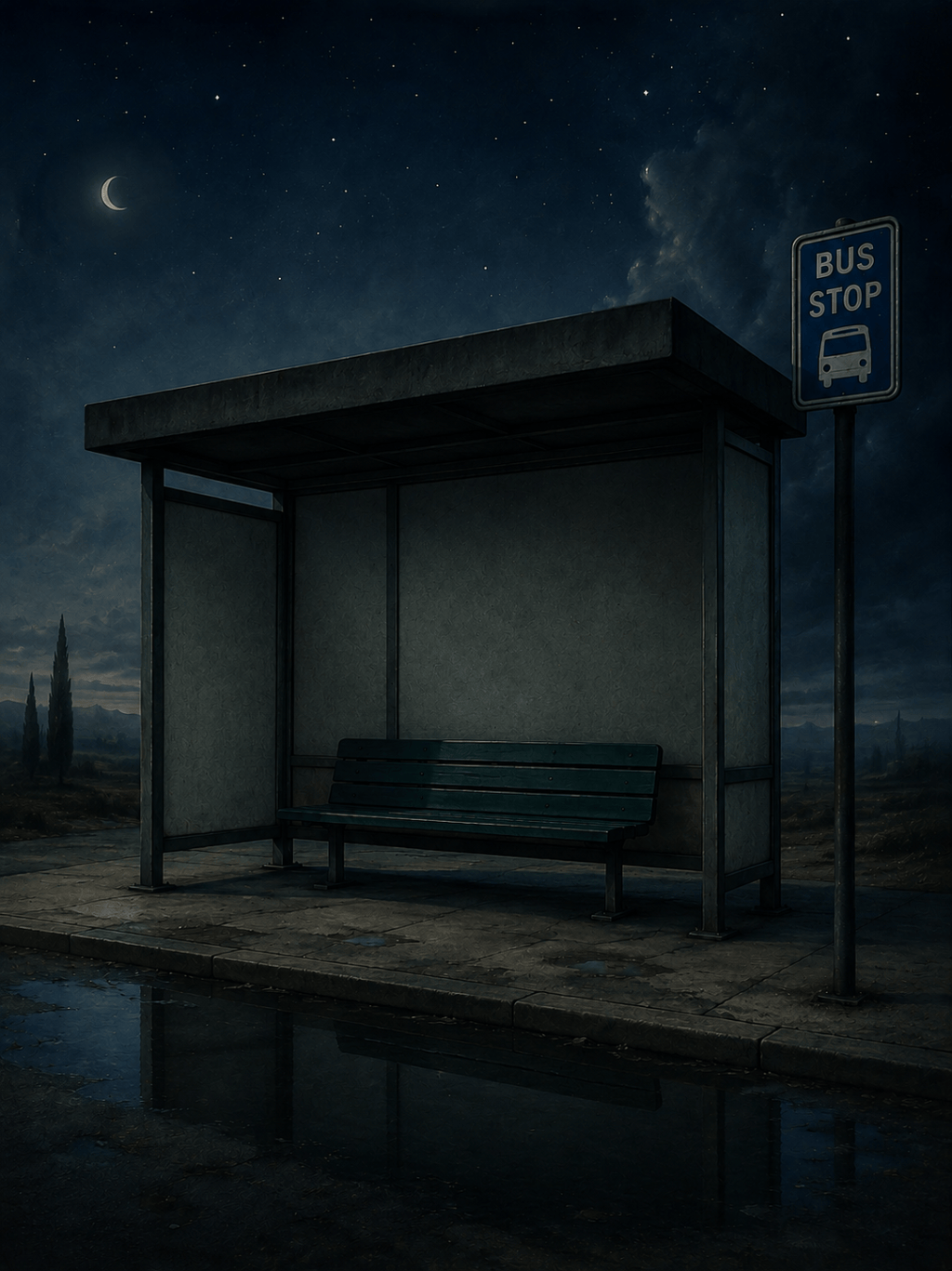
The road glistened with ice and puddles of melted snow, illuminated only by the lonely lamp post over the bus stop. There wasn’t much in the small shelter, save some needles and coffee cups and a bench designed to prevent anyone from lying down. The creature, that had once been a girl who might’ve been called Stella, sat down amongst the refuse and watched as the empty bus sped away into the night with a hydraulic creak. The creature curled atop the needles and garbage, uncaring of the little pinpricks that drew a festering excuse for blood from its body. It had become less than a ghost, less than a thought, merely a thing that seemed to exist without hunger or want. It seemed to have rotted from the inside out. The only bits and pieces left were the nastiest – terror, jealousy, anger – and even they began to grow quieter and quieter. The worst part, the part the creature despised the most, was that gleaming sliver of hope. Hope that a kindly stranger might pull over and wrap a blanket around the creature’s shuddering shoulders. The stranger might help the creature into the passenger seat and take it home, and tell it that the world was cruel but the creature was innocent, and dress it up in warm sweaters and tuck it in for the night. But the creature knew. It knew the truth. It would remain a creature all the same, and come daylight, the kindly stranger would see it for what it was – a slimy, broken, desperate thing doing its best to stand up straight in its pretty human clothes. The creature could not remember a thing beyond this fetid bus stop. Surely, it thought, this was all there was in the world. The creature was prepared to lie there forever. Maybe its mottled grey body would be discovered the next morning, but the creature suspected there was no such thing as morning out here.
Then something started breathing. At least the creature thought it was breath. It was a heaving sigh, repetitive, like someone in a deep slumber. In and out. The creature thought this was very rude, for something to be breathing so loudly when it was doing its very best to die at a bus stop. The creature wanted silence and blissful dark. It poked its head out, but either way was only a more eerie road going on and on until the light from the street lamp faded into black. The creature crept on its nasty little claws into the brush off the side of the road, disgruntled and numb and tired, and most importantly, annoyed. It scuttled and scampered and clambered and shuffled until the scratchy grasses and leaves gave way to something soft and cool. Sand, the creature thought. It had loved sand, when it had once upon a time been a girl. It had loved sand and sea and sky. The creature stepped forward, tentative. Suddenly, the silence at its back seemed suffocating and terrifying, grabbing at the creature’s knobbly spine with greedy fingers. The creature took another step, away from that stifling presence, and then it was running, bounding, until it crashed into the surf. Shocking cold folded over its twisty little legs, and it felt seaweed and rocks drag along its shins. The creature knelt and felt the ocean envelope it with a sigh. It tipped its head back and saw that the darkness had given way just slightly, the moon whisked out from under a cloud. The stars were splattered across the night sky in a dazzling display. They reflected off the sea as if it were a rippling mirror, two dark looking glasses speckled with light, stretching on and on until they merged into one. The creature glanced down and was startled by the reflection of a girl looking back. The stars floated over her head, like a crown, a halo, a string of fairy lights draped between the clouds. Her hair seemed to glow in the moonlight, shifting and curling around her face, her cheeks pink from the cold. The creature let its talons drop to the surface and peered in wonder at the reflection of pale fingers and human hands, watching them flex and dance in the waves. The girl and the creature gazed at each other, tilting their heads in synchrony, until the cold became too much. The creature struggled onto the rocks that jutted out of the sand and the waves like some amorphous mountain range, and wondered at the strange realm before it, at the girl trapped beneath the surface. Its toes dipped into the slippery rock pools that sat suspended between the land and the sea, and it sighed. The cool night air felt like velvet in its lungs and the ripples around its ankles tickled and caressed. The creature peered down and saw little shapes flitting and floating about, crabs and small fish and other squishy things that swayed with each drumming wave. It watched the perfect spiral of a snail shell carve a path in the algae, and the seawater trickle between the mussels and their spindly threads. It watched hermit crabs scuttle from crevice to crevice, curious eyes twiddling at it from where they gazed in the sediment. It watched tiny luminous jellies pulse through the water, leaving little eddies in their wake. “I think I might not be real”, the creature whispered to the things in the rock pool. They did not answer, but they did not seem to mind the creature being there, so it stayed with them and listened to the world breathe.
It turned out that morning did indeed come to the bus stop by the beach. It lit up the sky and the sea, pale blue and then pink and then orange. A girl lay just beyond the reach of the waves, letting the foam tease her fingers and toes, watching the darkness give way to a soft light. She traced all the things she knew into the sand: hearts and secrets and stick figures and equations and most of all her name. Stella, Stella, Stella, she said, again and again as the tide crawled in and surged over her markings. Stella poured herself onto the sand and then watched the giant heaving thing that was the ocean wash it away. As the waves pulled rivulets of water through her drawings, a sudden, single sob was wrenched from her. She pressed her sandy, grainy hands to her face. They smelled of seaweed and salt. She wrapped her arms around herself, kneeling on the beach, and began to cry. The tears seemed endless and painful, the kind of sobbing a child does, snotty and keening and gasping. She expelled. Eventually, the tears slowed and turned to shuddering breaths that rocked her body. Stella opened her eyes to the peach coloured sky and the gentle thrumming ocean, and shakily stood up. Feeling as if she had not used her legs for a very long time, she walked up the hill to the bus stop.
She waited there for a while, listening to the great crashing of the sea and the caw of the gulls and the rustle of the dune grasses. Eventually, the bus came tearing down the road and squealed and jolted to a stop where Stella leaned against the tiny slanted bench.
“Good morning, lady,” called the driver.
“Good morning,” Stella smiled back. The smile was hard. It made her face hurt. She held it for as long as she could, and let a few coins clatter into the slot by the door, while the driver pretended it was enough for a ticket. Stella stumbled into a seat as the bus took off, leaving the little shelter and the dunes and the glittering sea behind. She watched the beach give way to a blur of green and forest, letting her head vibrate and bounce against the window. They sped along the winding road back to the city, past rows of mailboxes, a dog bounding through the dusting of snow on a front lawn, and a cafe flipping around their open sign. Street lights turned off and kitchen lights turned on. She always listened to music on the bus, she realized, but for once Stella was satisfied just watching the world wake up.
Isabel Ross is from Texas, but grew up in Uzbekistan and is now a marine biologist living in Halifax, Nova Scotia. She has a profound love of our natural world, and a healthy respect for how science can be used to protect it, complimented by an equally healthy respect for her desire to no longer be a scientist. She hopes to continue writing and finding ways to have a positive impact in the creative world that incorporates the lessons she has learned in the not-so-creative world.

