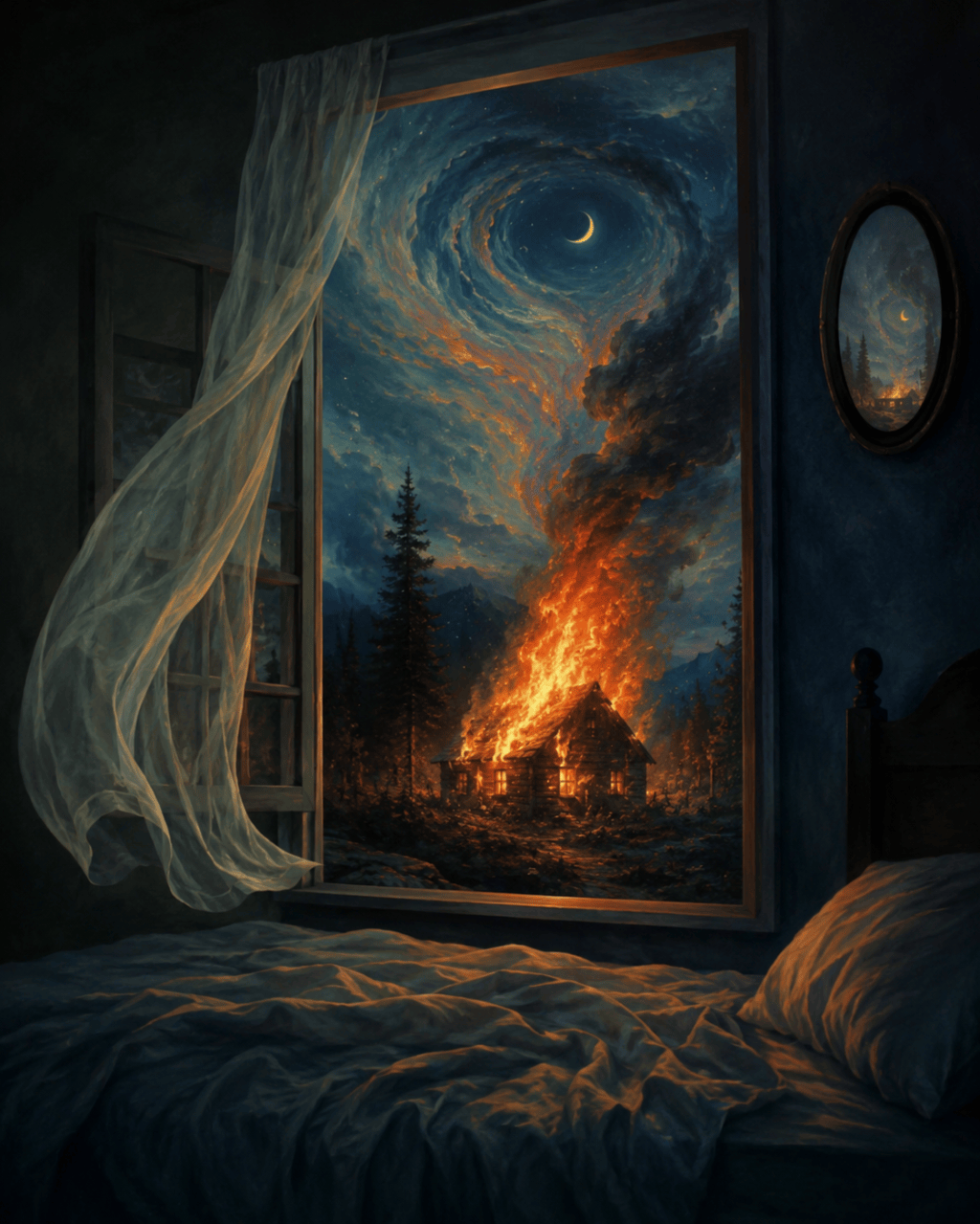
I finally understood what it meant to be dead.
Time unraveled quicker than my understanding. Winters came and melted into mud, then returned again, and I felt each one only by the way the cabin changed. Fresh pine stacked by the porch. Wet boots by the door. Garland in December. Dust in summer. I could not sleep, could not hunger, could not leave. I could only remain—an unseen figure.
I had always thought haunting moved in one direction, something the dead did to the living. But as I stood there watching the world continue without me, I couldn’t decide what was worse: being remembered or being forgotten.
At my feet lay the evidence of my latest mistake—a picture frame split at the corners, its glass cracked down the center like a fault line. The photograph had slipped free and curled at the edges as if it, too, wanted to disappear.
For a moment, no one moved.
Then Lance laughed.
It wasn’t the laugh I remembered. That one had softened at the edges, meant only for me. This one came easier, lighter, as if it belonged to someone else entirely.
“Oh, this cabin might look new,” he said, glancing around the room, “but I swear it’s still got all the old creaks and wear and tear.”
A few people chuckled. His father shook his head while his mother bent to gather the broken frame from the floor. She didn’t pause at the photograph or the crack running straight through where my face had been—though perhaps she noticed and chose not to.
I followed her hands as she lifted it, and for a moment the past returned whole. Snow dusted our shoulders in the image, caught in my hair, clinging to the wool of my scarf. Lance stood behind me with his arms around my waist, his chin resting against my temple, both of us smiling. My hand covered his. The ring caught even the faded light of the print, and I remembered its weight when he slipped it onto my finger—the warmth of it, the way it had felt…
The trash lid shut, and something in me went with it.
Around me, the room continued as if nothing had happened. Someone uncapped another soda. A child ran past with frosting smeared across both hands, shrieking with laughter until his mother caught him by the sleeve. Boots thudded across the porch outside. Cold air—I assumed—rushed in when the door opened, carrying the smell of pine and melting snow before it vanished again beneath warmth and woodsmoke.
Every sound belonged to the living. Every careless movement, every unfinished conversation, every hand reaching for another hand. They inhabited the room so completely there was nowhere in it for me. No one looked twice in my direction, no head turned, no voice faltered. By then I understood that much: I could rattle the edges of things, but not the people inside them.
Only Quinn watched me.
He sat beneath the side table, tail wrapped around his paws, yellow eyes fixed where no one else thought to look. I had never liked him much when I was alive. He had a habit of appearing soundlessly in doorways and staring as if he knew something unpleasant. But he had always been drawn to me in the same quiet, persistent way, winding around my ankles when I wanted to be left alone, waiting outside closed doors, watching.
He watched me now.
Then someone laughed across the room, and the sound pulled my attention back to the living. Lance was there, angled toward her, one arm stretched across the back of the couch, his fingers brushing her shoulder as she spoke. I couldn’t hear her words, but it didn’t matter. He was listening in the same quiet, attentive way he had once listened to me, as if everything else had faded.
Her hand rested against his chest, and when the firelight struck the diamond, recognition came before denial had time to form. For a moment I wanted to believe it only resembled mine, but then I recognized the setting, the curve, the exact shape of the band.
It was the same ring. He had slid it onto my hand with shaking fingers, laughing at himself for being nervous. He promised forever, as if he owned time itself. I had believed him because loving him felt safer than doubt.
My hand lifted before I could stop it, reaching toward hers, and I expected resistance—the brush of skin, the interruption of contact—but my fingers passed through nothing. She didn’t react. The ring didn’t move.
Lance laughed again, answering his love’s question about the cabin.
“It was an accident,” he said easily. “People think it’s haunted because things break, but it’s just an old place.”
An accident.
He said it like something that no longer mattered—something forgettable.
Then Quinn cried out.
The cat stood near the edge of the room, staring upward at the rafters where new beams crossed cleanly overhead. The wood was lighter than I remembered, replaced after the fire, reinforced and restored, and the sight of it tore loose a memory before I could stop it.
Heat returned without warning—not as thought, but as a sensation. Smoke pressed into my throat. My hands remembered wood that would not move, splinters under my nails, the weight above me refusing to shift no matter how long I tried. The cabin had ended here once, or I had, and the difference no longer felt important.
The memory broke, leaving only the present behind.
Quinn moved first, slipping toward the hallway, and I followed gladly as the sounds of the living fell behind us. I had drifted these rooms longer than I could measure. Time did not move cleanly anymore. Days blurred into nights, winters into thaw, voices into silence and back again. I knew the cabin by habit rather than memory.
Then there were others I never entered, places I avoided without understanding why: the front window where snow gathered against the glass, the kitchen where morning light once fell across the table, the porch where the wind moved through the pines and almost felt like touch.
Then there were others I never entered or consciously observed: the rebuilt rafters above the living room, the blackened crawlspace beneath the stairs, and this hallway—it always seemed darker than the rest of the house. Even when the rooms were full of laughter, the shadows here held their shape.
I had never crossed into it. Never dared investigate. But with Quinn moving ahead of me, tail low and certain, the darkness no longer felt threatening. It felt like an invitation.
Quinn stopped at a door, and I recognized it without knowing how. It was identical to the others, but that wasn’t what made it wrong. Something dark twisted through me as my gaze traced the door frame.
Quinn scratched at the base of it once, then again, sharper this time, while I stood motionless for a moment too long. When I finally spoke, my voice barely carried.
“I can’t.” The words had no weight.
He waited anyway.
When I reached for the handle, my hand slipped through on instinct. I tried again and met only emptiness, the metal indifferent beneath my grasp. Quinn’s cry sharpened behind me, and I closed my eyes—not to think, but to stop thinking—before reaching once more.
This time I focused only on the certainty that it existed whether I was allowed to touch it or not. Resistance met me, faint at first, then steadier, until the latch shifted with a muted click. The sound was so small I almost doubted it, but the door gave inward beneath its own weight.
I stayed there a moment longer, my hand resting where substance had briefly answered me, before pushing it open enough to pass through.
The cabin fell quiet at once. The voices behind me did not disappear, but they sank beneath everything else, and even the fire’s crackle softened as if distant.
Quinn slipped past my legs and leapt onto the bed, circling once before settling into the rumpled blankets as though he had always belonged there. The useless creature casually licked its paws as if it needed rest from its hard labor.
I remained near the threshold as a cold weight settled over me, stealing breath from thought itself. It wasn’t grief or anger, not even the hollow ache I had learned to live with. Those had become familiar enough to pass through like weather.
This was older.
Fear.
As it settled, the room came into focus. The bed was unmade, the sheets twisted as though someone had risen in haste. Clothes lay scattered without care. A glass sat on the nightstand beside a charger cord, and a watch I didn’t recognize caught the dim light.
Lance still slept here—or had. That realization struck harder than fear itself. Whatever had happened here, he had gone on living beside it. This room—the one that had once filled with smoke and heat—had not been preserved or sealed away in remembrance. It continued to be lived in.
I moved toward the bed before I decided to. My hand reached for it, passed through fabric, then caught—just barely—on the edge of the quilt. That touch was enough.
Darkness took me.
I woke alone.
The other side of the bed was empty, already cooling. At first there was only confusion, the dull haze of waking too quickly, until the smell came—sharp, heavy, and wrong. Smoke pressed low across the ceiling in thickening layers. Heat followed fast, turning the air hostile before I could fully rise.
I called again, louder this time, voice torn apart by the smoke. Nothing but the crack of timber and the hungry rush of spreading flame. Somewhere below me wood groaned and collapsed. Sparks drifted through the doorway like insects made of light. The heat was no longer around me but moving toward me. I stumbled from the bed, choking, reaching through smoke for a shape that refused to exist.
The memory shattered, and my hand snapped away as if burned.
Quinn watched from the bed, unblinking.
Certainty settled into place. The explanation I had been given—accident—no longer held. The room—the memory—did not match it. The details refused to align.
I had called for him.
I had woken alone.
He had known about the fire before I did. Why else did he pour a drink one after the other, only to hand it to me throughout the night? I was so tipsy, he would have known I couldn’t escape in time. Why then would he abandon me? I loved him. I thought he loved me.
The realization hit me harder than the fallen rafter did that night. The way the heat spread through my body, the wood glowing red as it pinned me to the caving floor. The flames swallowed me, and so did my final understanding.
Heat rushed through me, sudden and absolute, and for the first time since death it felt like fire again instead of memory. It crawled beneath my skin, familiar and merciless, returning something I had thought dulled with time.
I understood then that haunted had never belonged only to houses. I was haunted by the ring on another woman’s hand. Haunted by the family who spoke of renovations beneath beams that had once pinned me down. Haunted by Quinn, who had led me here piece by piece.
And haunted most of all by the cruelest truth: I could stand inside the remains of my own ending and still be the only one left carrying it.
The room seemed to contract around me and I stopped resisting. The cabin no longer felt like a place I was visiting, but a place that felt like it had been waiting for me to understand it correctly.
I returned to the living room. The fire was still burning. Lance was still laughing. His mother was slicing cake. A child had fallen asleep across two chairs. Someone argued cheerfully over cards at the table. Lance leaned close to her—my ring flashing as she touched his wrist—and smiled the smile he once reserved for me.
The world had not changed. But I had. They say love ends in death, but death had ended nothing for my sake. It had only removed the blindness I carried in life.
The flames twisted and turned in the fireplace, as if calling and reaching for me to rejoin them. Unwanted flashes of burning skin and the sound of my hoarse voice broke through the numbing thoughts. They did that to me.
He had left me there to burn.
Laughter continued around me, free of the terror I went through alone.
That was until the fire leaned toward me, and I welcomed it home. The flames seemed to gape and maw, asking to be set free once again in the cabin. I reached for the waiting warmth of the fireplace, and the flames rose to meet my hand.
Why should I be the only one to burn?
If I was to remain here, then I would not remain quietly.
Let them scream. Let them run. Let them hide. Let them be haunted properly.
Emilee Alvord is an English major at Utah Valley University, originally from Lindon, Utah. When she isn’t writing, she can be found capturing nature through a camera lens, playing the piano, or exploring the mountains with an animal in tow. ‘Haunted’ was the first short story she ever submitted for publication, making it her debut piece.

