Career Day, not Arthurs’ favorite. Plumbers, podiatrists, pool installers, policemen retired at fifty to make outrageous sums as insurance investigators. They spent the better part of their presentations bragging about party boats on Greenwood Lake. Over twenty years Arthurs had heard them all. Bumblers. Blowhards. The few who passionate cared about their work. His best students–the funniest, the most curious–dreamed of becoming comic book illustrators or Instagram influencers, of daring to succeed in the big glitzy world, but the PTA sponsors of Career Day were relentless pragmatists. Fine, if their daughters wanted to cram all the melodramatic books they could into high school, but soon they would need to learn what it meant to be financially responsible.. (Their sons they just wanted to keep out of jail.) This year alone the PTA had suggested a nurse practitioner, a tree doctor, a warehouse manager (Amazon, of course), all of whom happened to be friends of parents and some of whom, no doubt, were prospecting for minimum wage summer staff.
Enough was enough. Close to retirement, Arthurs no longer felt beholden to every beck and call of the PTA. Browsing the internet one morning at coffee break he discovered that Orange County had a Poet Laureate. Who knew? But, indeed, little old Orange County, onion capital of New York State, if not the world had its very own Poet Laureate, who’d recently spoken at a park picnic area dedication. An ode to outdoor grills, perhaps? Arthurs, himself, had written some poems during an especially emotional spell in his youth. A young lady perfectly designed to turn him inside out. A total embarrassment, those poems, but, really, what was the harm? High school was high school, the boot camp for life. Didn’t his students–the bright ones, at least–deserve an afternoon of creativity before they trundled off to trade school?
Milby, who insisted upon being called by one name only, wasn’t quite what Arthurs anticipated. He arrived more than an hour early, costing Arthurs his free period to catch up on emails and the latest Trump travesty. Nor did he look very Bohemian, more like an old-fashioned boarding school teacher with his chestnut hair parted in the middle and the elbows of his corduroy jacket covered with brown patches. The wire frames of small eyeglasses looked so thin they would need delicate fingers to handle. Arthurs wondered if this position of Poet Laureate was a throwback to the Victorian era when poetry rhymed and poets wrote dedications to statues. Not that Arthurs would mind. He’d had a weakness for Browning, Tennyson, the noble tradition. But today’s students were merciless towards anything that wasn’t rap.
Fortunately, Milby had a strong voice and a hardy manner. He could command a room. He also carried a hard Samsonite briefcase that reminded Arthurs of the sample cases that door-to-door sales men had lugged around years ago loaded with table polishes and glass brighteners. Maybe being Poet Laureate wasn’t so different from ringing doorbells, a job that demanded stubborn optimism. Milby didn’t strike Arthurs as the type for moping around or jumping off bridges. No sir. He asked for a cup of coffee black–no pollution, please–and talked about all the places he’d given readings: churches, cafés, nursing homes, schools, libraries, wineries, art galleries, two or three ashrams. Arthurs had forgotten the county still had ashrams. The high school hadn’t had a student dressed in a white turban in years. The ashram dwellers, like everyone else of culture and taste, had grown old.
The period bell rang, and Milby asked to use the Boy’s Room on the way, joking that he didn’t have the spare tank he needed for all the coffee he drank. By now Arthurs two great questions had been answered. Milby explained that a friend of his aunt’s who worked in the county office had created this title for him, a story Arthurs appreciated because it proved that poetry existed within the same system as everything else in Orange County, who knew who. And Milby acted graciously enough at receiving his $100 honorarium check that Arthurs knew the guy wasn’t getting rich off tip jars at coffee houses. Upstate New York, the land of scraping by.
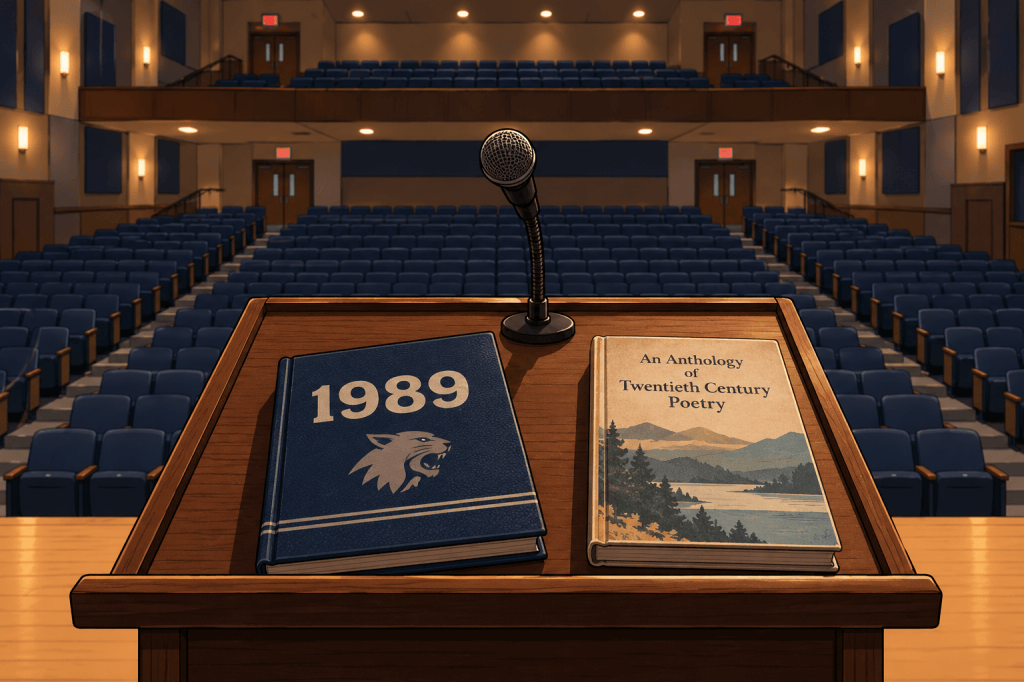
The large auditorium was sparsely filled, no surprise for Career Day unless Arthurs brought in a state trooper or an exotic dancer. (To be clear, Arthurs had never brought in an exotic dancer.) Twenty or so students scattered in clusters among the tired red seats was par for the course. Poetry did no worse than podiatry or pool maintenance.
“Last year we had a mortician,” Arthurs told the assembly for his introduction. “He told us the good news that nothing would ever put him out of business, not the internet, not foreign competition, not even better health insurance, which we certainly need. No sir, his job was guaranteed for life. Something tells me that this year’s guest speaker, our very own Orange County Poet Laureate, has also chosen a profession in no danger of disappearing any time soon.”
Milby hoisted the Samsonite case onto the podium and unclicked the latches loudly into the microphone. Snap. Snap. Pistol cracks. Out came a handful of dog-eared college paperbacks leafed with yellow post-its. Arthurs sensed trouble ahead. Goshen High wasn’t Greenwich Village.
“Yarrrgh!” announced Milby into the microphone. “That’s how we begin poetry readings, my fellow pirates and me.”
“I,” Arthurs thought. The proper syntax was “I.”
Milby lifted out a yellow legal pad that looked heavily thumbed.
“On this day in 1873 Edgar Wellington Bosworth, the great poet of onions, died at twenty-nine,” Milby said. “Complications from syphilis, I’m afraid. Forgotten today, but we should remember him in here in Orange County, the black dirt capital of the world.”
Milby paused to take an audible sniff at the microphone. His eyes closed as if savoring the aroma. “You can even smell it right here in this auditorium, if you’re pay attention.” A second deep sniff amplified like a vacuum. “And if you’re not paying attention, you don’t belong on this fertile rich earth. Quit wasting our time and go back to your video game.”
It was true, Arthurs had to concede, especially at this time of spring after the farmers had manured their fields that the pungent odor of the Onion Capital was hard to escape. In fact, he had his own private theory that this stink had the subliminal power to make the students even more obnoxious. It was as if the planet itself had farted.
“God’s green earth,” said Milby in prayerful tones. “The dirt where everything goes when it dies. Where everything new gets born out of the muck and mire.”
Arthurs feared what the students must think of this man treating the scent of manure like wine.
“Not that you should believe in God, of course. Except as a poetic device.” Milby gave a sly smile and leaned in closer, one of those performers who feasts on the mik. His gaze dared the audience to be bored.
“Here in Orange County it’s the witches and the goblins that still speak to us on the long dark nights black as the soil. You hear their cries in the broken trees and in the broken barns that refused to fall over. You hear it in the hour before the cracked church bell finally rings. Your hear it in your soul when you have no choice but to be honest with yourself. The hour when, once again, you must decide whether you want to live or die.”
He unlatched the Samsonite case a second time to lift out a baggie fat with fine black powder. Arthurs felt his heart stop. A Career Day poet flashing his drugs, an unforgivable offense. Except the powder looked worse than drugs. It looked awfully much like cremated remains.
Milby held his nose over the open baggie for another great inhalation.
“O, how I love our soil,” he said. “I take a spoonful of it every day. Every poet should. You must know the true taste of life, if you want to write about the true and the beautiful.”
Expect he didn’t take a spoonful. He scooped a smidge with his pinkie nail and jerked his head upwards for a secretive snort followed by his fingers pinching his nostrils lest anything leak out.
Getting high off the dead? Now Arthurs could truly say he’d seen everything at Career Day.
Milby zipped the baggie tight and tucked it in his jacket pocket like a tobacco pouch for a pipe. And he did have the manner of a pipe smoker from the old days, a ruminative fellow with a tight jaw and the patience to deliver his slow stately thoughts. He returned to the yellow pad.
“And on this day in 1942 the great poetess of Middletown, Francesca Twinings–“
“Mister, come on. I’ve got my hand up.”
They really had no manners did they? Arthurs should have prepped Milby for what to expect from today’s students. Manners hadn’t been seen around here since 1994.
“Do we have a Twinings reader among us?” Milby said as he looked up into the distance. “You’re few and far between, but not unappreciated.”
“Don’t you work at the Stewart’s out on 44?”
“Sometimes,” the poet replied.
“I knew it,” said Stevens, the clown always seated in the rear. “Same guy as the ice cream.”
“Double fudge crunch.” added his neighbor.
“Cookie dough.”
“Mint swirl.”
Arthurs lowered his eyes. Like jackals the comedians were out. Career Day down the drain.
“You got a poem about ice cream?”
“How about gasoline? You got any poems about Stewarts’ gasoline?”
“Gasoline?” Milby said. “You mean the classic poem “Gasoline” by Gregory Corso. Born March 26, 1930. Aries. You know what that means, especially when you put him in bed with Allen Ginsberg.” He began flipping through an anthology as well worn as a preacher’s Bible.
“There are so many poems,” he said. “It’s hard to know where to begin.”
“How about an oil change?”
“A squeegee wipe.”
The list of demerits was adding up fast in Arthurs mind.
“Here’s one you should hear,” Milby said. He put down the anthology to pick up a single white page. “Not very well known, but it should be. A fine piece of work.” He took his first sip of water from the plastic bottle that had been left in the lectern. “It’s called ‘First Love.’ It’s by Jerome P. Arthurs. Class of 1989.”
Arthurs wanted to die. How in God’s name had Milby found the old yearbook?
Milby read with a booming voice.
Once engaged to the Bride of Amazement
I tried and tried but could not remember why
She saw the dawn and gave a startled cry…
Word for word stolen from Edna St. Vincent Millay. Milby read with such gusto. Surely, he must have known. Yet Arthurs couldn’t help but smile. Poetry was such a lovely lie. He’d been a fool to ever let it go.
Will Nixon‘s poetry collections include My Late Mother as a Ruffed Grouse and Love in the City of Grudges along with two town portraits in poems, Acrostic Woodstock and If Not in Heaven, Then in Saugerties. He wrote The Pocket Guide to Woodstock and co-authored Walking Woodstock: Journeys into the Wild Heart of America’s Most Famous Small Town. He now lives in Kingston, New York. His website is willnixon.com.

