The pit, at first, could not rightly be classified as a pit, but more of a hole. It appeared one day in the center of the town square. It was roughly the depth and diameter of a bucket that a child might build sandcastles at the beach with. It was also curious for its uniformity. Someone had managed to dig a perfectly smooth walled hole into the concrete walkway without making any noise or being noticed.
The hole was first reported by a child. They had almost twisted their ankle in it running through the square to catch the bus to school. The child told the bus driver who informed their teacher who kicked it up the ladder to the principal who eventually called the town’s mayor. The mayor, annoyed at being bothered with something as insignificant as a pothole, instructed the deputy mayor to go buy a bag of soil from the florist and to fill the hole with dirt. The deputy mayor carried out this task solemnly and planted a small bunch of forget-me-nots in the center of the hole. He reported back to the mayor who considered the matter resolved and informed the school principal. The child’s parents were called over the incident and reassured that the child and their ankle was fine. There were no more problems that day. At least none that were reported to the mayor.
The following morning the same child was running through the square to catch the bus to school. They were running late and had already forgotten the drama of their ankle. They took the same path with the careless speed of a young boy. Their leg was caught in the hole again, but it was deeper now, and empty of soil and forget-me-nots. The child fell forward and began to cry, more from the shock of the fall than their skinned elbows and forearms. With tears in their eyes and blood on their school uniform, they hobbled to the bus. The driver looked at them in alarm. He called the mayor directly.
Thirty minutes later, the mayor stood at the hole for the first time. He trusted the problem had been solved. He pointed at the hole and said to his deputy, “I thought you filled this.”
“I did sir, I even planted a small bunch of flowers so people would not miss it.”
The mayor frowned and bent to inspect the hole further. It now had the diameter of a beach ball and was roughly two feet deep, at least by his estimate. The hole remained perfectly circular with smooth walls all around. There was no trace of dirt in it. The mayor grimaced.
“I thought you said it was a small hole. This one is quite big.”
“It was sir. It has almost doubled in size. Perhaps the ground underneath is unstable? The beginning of a sinkhole?”
“No. It’s too perfect. This is man-made. Someone is making a fool of us, of me. In an election year no less. That must be it. This is someone’s idea of a protest. They aim to humiliate me. Say I do so little for this town I can’t even fix a pothole! Well, it will be me who laughs last! Schedule someone to fix this. Well mixed concrete, a smooth pour. I want it indistinguishable from the rest of the square. I will not be insulted.”
“Yes sir, of course,” said the deputy, but the mayor had already stalked off.
There was only one company in town that poured concrete. It was a small town but there was an expert for everything. Two workers were dispatched to patch the hole. It was an easy job for men of their skill. They worked quickly yet diligently. Their company had also poured the concrete for the square some fifty years ago. They knew how to mix the new batch to match the old one in color and texture. They finished the work by cordoning off the freshly patched hole with orange traffic cones linked by yellow caution tape.
“It will take a day or two to set depending on the heat. But the hole is fixed,” reassured the men to the deputy mayor.
The following morning the child was escorted through the square by their mother. They left home early and walked carefully hand in hand. There was no sign of the orange traffic cones or yellow tape. The mother stopped short and jerked the child back violently. They had unknowingly walked to the edge of the hole. It was now almost ten feet deep and a stop sign’s length in diameter, to her eyes at least. Together, mother and child carefully navigated around the hole to the school bus. She called the mayor’s office as they waited.
The adults of the town gathered for an emergency meeting that night. The mayor stood at the podium, the red in his face rising with his anger. The buzz of voices was shattered by three sharp smacks of a gavel.
“Silence!” the mayor shouted. “I am sure you have all noticed the growing situation in the town square. I have called this meeting to get to the bottom of it. This wanton destruction of town property will not be tolerated!” he emphasized with another bang.
“I almost fell into it yesterday!” a voice shouted. “Damn near killed myself!”
“Soon it will be at the footsteps of my restaurant! How will you compensate my lost business?” shouted the owner of the nearby ice cream parlor.
“Silence!” shouted the mayor again. “I know it is one of you who continue to dig this hole and I will prove it. While you were busy gossiping, I have had the doors of this room locked. When we emerge tomorrow morning to find that the hole has not grown, you will be unable to protest your innocence. Then I will sniff you out, whoever you are.”
“You’ve gone mad! What about my kids? Who will feed them? Put them to bed?”
“They will survive one night. If you are not guilty, perhaps your energies would be better spent finding which one of your angelic neighbours is responsible. A heartfelt confession and we all go home,” he sneered.
The townspeople began to confer. Friends confirmed their innocence with friends. Neighbours with neighbours. Accusations were thrown but quickly unsubstantiated by alibis. No one stepped forward and no suspicion held firm through scrutiny. Hours passed and the mayor grew bored and took to the podium.
“It seems we are sleeping here tonight even though I detest the company of liars,” he said into the microphone before sulking off to a corner.
The townspeople whispered amongst themselves.
“It’s just one night. It’s best not to anger him further when he’s in this mood.”
“Do we even know the doors are locked? Maybe he lied?”
“No, I checked. They’re locked. It feels like something has been placed against them on the other side. We’re stuck here.”
“He’s lost his mind.”
“If not one of us, who is digging the hole?”
“Don’t be a fool. Of course it’s someone here. But do you think the person capable of such a stunt is also capable of confession.”
“Hush! Some of us want to sleep.”
The conversations slowly broke apart. Night and sleep crept in and the town slumbered.
The townspeople were anxious to leave the hall in the morning and they crushed up against each other waiting for the doors to open. They spilled into the street like marbles tumbling out of a jar but the mayor stomped out far in advance of them. He headed straight for the hole muttering about vindication. The townspeople with no children to rush home to followed the mayor closely behind out of morbid curiosity. He stopped abruptly just before the town square and turned to look back at the advancing crowd with a sheet white face. The townspeople gathered around him and looked at where their square used to be. The hole had grown over night. It was no longer a hole; it had evolved into a pit. A deep, dark chasm. It was perfectly circular with smooth walls all around. While the mayor could estimate its diameter – roughly one town square in width – he could no longer fathom its depth. There was only darkness when he peered over the edge to find its bottom. Deep, black, nothingness.
†
After a few weeks it was clear that the pit had stopped growing and this eased the town’s collective mind A makeshift square was set up in the park where people could still gather in the evenings to gossip and exchange news. The mayor delegated the organization of a search crew to investigate the pit but it was proving difficult to find volunteers. A sort of reverence had spread through the townsfolk. They were thankful it had not grown even larger and feared angering it.
Soon, people even found use for the pit. They began to dump their garbage and construction waste in it. They would wait at the edge for the clap of their jettison hitting the bottom but no sound ever came. Tourists visited from neighbouring towns and cities to see the pit. They contemplated its captivating darkness and could stare for hours before someone snapped them back to reality. For a time, the pit was a boon to the town, until it spoke.
“More,” the pit said one early morning with a deep voice that echoed through the town. The voice resonated in the chest of every townsperson. They felt the words as if spoken from their own lungs. One by one the town assembled at the edge of the pit to look fearfully into it.
“More,” the pit demanded.
“What do you think it means?” asked someone to the mayor.
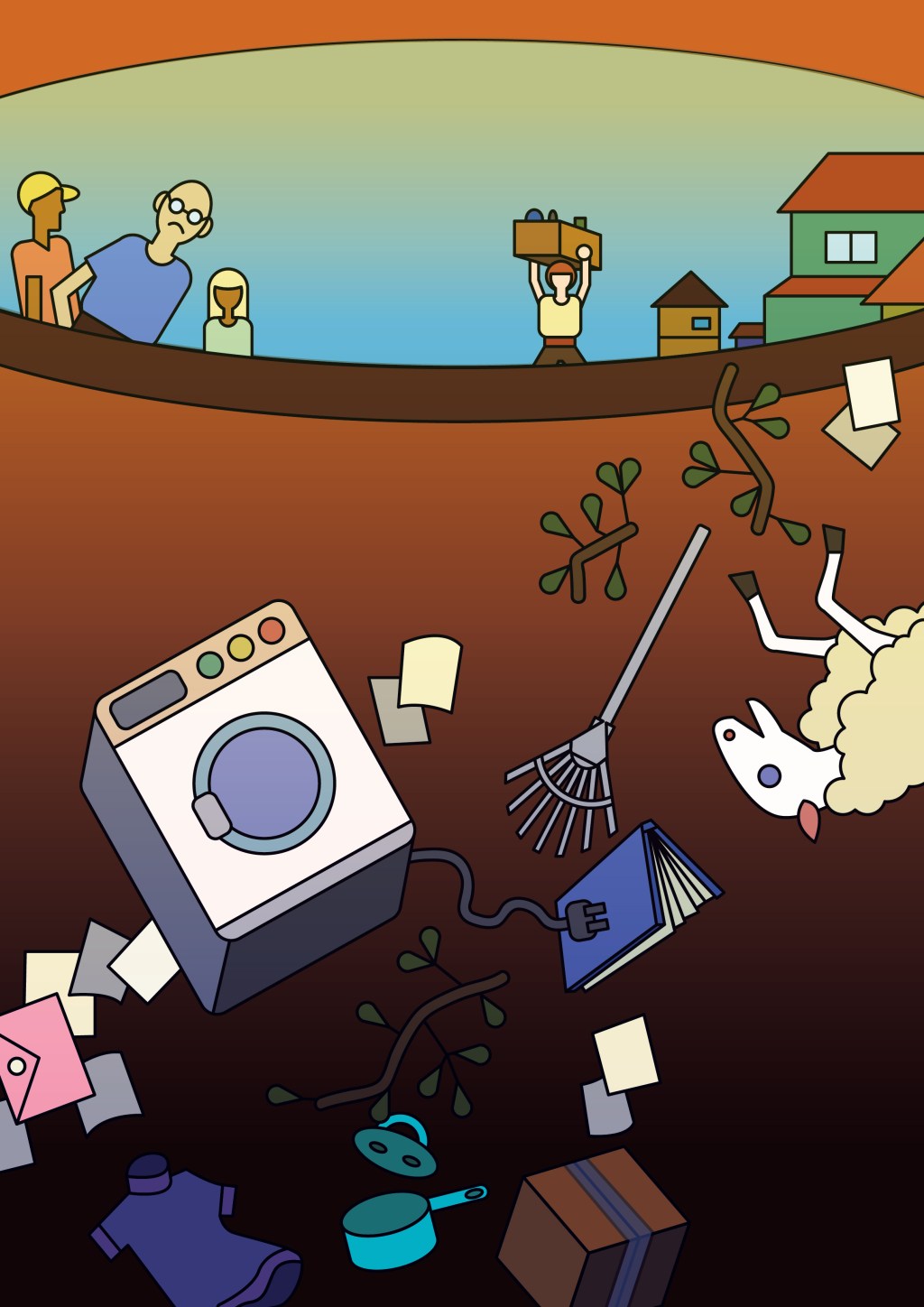
The mayor looked at them with red, watery eyes. “We must give it more,” he said before trudging back home. After a few minutes, he returned with a stack of plates and some cutlery and threw it down the pit. Silence. Not a sound or voice could be heard. A few more people splintered off from the group only to return carrying old textbooks or out of date DVD players and chucked them down the hole. Ripped pillow cushions, hand-me-down overalls, out of warranty washing machines and boardgames missing pieces tumbled down the pit. Records of filed taxes and copies of birth certificates and old children’s drawings no longer taped to the fridge floated gently down into the pit. Yard clippings and semi-dead flowers prematurely ripped from vases and bundled up tree branches briefly left the scent of fall in the air as they too were tossed into the pit. Not a sound was heard except for the grunts of the townspeople as they tossed more and more and more into the pit. Sweaty from exertion and the rising noonday sun the frenzied dumping stopped and the town quietly panted in unison. No voice came from the pit.
Two weeks later, or maybe three, the voice was heard again. “More,” it grumbled. The townspeople gathered and begun dumping refuse into the pit, but this time the voice did not stop. A farmer left and came back with one of her sheep. It bleated in fear as it was pushed towards the edge of the pit. All was quiet except for the desperate scrapes of its hooves on the sidewalk before it mercifully fell over the edge. “More,” the pit replied. The other farmers went back to their barns and returned with cows and horses and sheepdogs and chickens. One by one they obediently walked over the edge. The rest of the townsfolk stood in horror as the parade of animals showered down into nothingness, their cries swallowed by the deep, dark pit.
People started to leave town after that. The horror of imagining what the pit would demand next was too much for some. They left their belongings with those who stayed behind, “Throw the house in brick by brick if you must,” one tearful woman said to her neighbour. “Give whatever you want from here,” she said before driving away, the pit a frightful presence in her rear view mirror. Still others remained. Either paralyzed by fear or kept in place by aging bodies or aging families they hoped that the pit would leave as mysteriously as it had come.
The pit, however, remained. The townspeople gave it a wide berth if they had to pass through the city center. They would imagine black, menacing heat rising from it, like the air rising from desert sands, but this was just their imagination. The pit was cold. It emanated no heat. No sound could escape it. No light could penetrate it. The pit simply was there. It was fearsome and grand and unfeeling.
Months passed before the silence was broken again. The townspeople fell to their knees in supplication before the pit as they heard the cavernous voice make its demand.
“I’ve nothing left to give,” a teary-eyed person whimpered. “I live in squalor. My animals were sacrificed, my belongings thrown away. There’s nothing left.” A chorus of knowing nods came from the crowd.
A man stepped forward to the pit and leaned over the edge. The immense blackness before him played tricks on his eyes and he imagined a vast, churning ocean below. He could hear the roar of the waves as they crashed against the walls of the pit. His ears filled with sound and he felt the salty spray on his tired face. He leaned over just a bit more, hypnotized, and was airborne before he knew it, falling into that deep, unknowable ocean. The pit was so much smaller when I first saw it, thought the mayor.
That night the deputy mayor formerly assumed control of the town and swiftly enacted a vote on his proposal for how to deal with the pit should its demands continue. The measure barely passed.
A few days after the accident, if it could even be called one, the bass voice of the pit gurgled for more once again. The townsfolk gathered around the pit for what felt like the thousandth time and pushed the deputy mayor forward towards the edge. He dabbed the sweat from his neck and over his trembling lip with a handkerchief before tucking it back into his pocket and addressing the pit.
“Hello, great and mighty pit. I am the mayor of this fair town and we come to you with a proposition.”
The pit remained silent. The former deputy mayor looked back at the crowd to see a few in the front flick their wrists at him like when one shoos a cat out of a room. He nodded and turned back towards the hole.
“Hear me pit!” he cried. He fell to his knees with his hands stretched downwards towards the great black unknown. “We were not a wealthy town but we had enough and we prospered and loved each other and lived together well. We are now left with nothing after your arrival. We have nothing of value left to give you, save our lives, but we still cherish the hope that our fortune may one day turn and thus we cannot sacrifice them. We hope you will accept our feelings in exchange. And for any future child born within this town they will sacrifice their feelings to you too when they come of age. Grant us this exchange, we beseech you!” the mayor yelled, slamming his forehead to the ground with a flourish of supplication.
Time stretched into eternity as the town waited for a reply. The birds in the sky flew silently as if they too were waiting for the pit’s response. The ground beneath them started to shake and tremble and the townspeople feared they had angered their malevolent god to the point of expanding once again, but soon they realized it felt more as if the pit was filling its rocky lungs with air to finally reply with a deep exhale, “I accept.”
The mayor was filled with joy, but only for a moment, because joy soon left his body, shimmering gold and racing down into the pit like a shooting star. He gasped in alarm before that sensation too fled from him, speeding down as if it were being chased. The townspeople ran up to the pit, dragged by the feelings that were being pulled from their souls and saw them consumed by the hole as well. Happiness and cheer danced and bounced on their way down, while others brusquely brushed past them on their descent, like anger and the red hot ball of rage. Sadness floated above the hole, a purple cloud, before sinking down like a balloon that had lost its helium. Lust and jealousy intertwined like snakes as they slithered down the impossibly smooth sides of the hole while love flew through the air like Cupid’s arrow. Shame and guilt, cloaked in grey, sought to hide from the others as they too were dragged down into the pit. This went on for hours until even the most obscure feeling had been vacuumed out of the town’s souls. Ahead of them was only a grey, muffling fog to stumble through until their time had come to an end. The only certainly was the pit would torture them no longer. If the town remembered what relief felt like, they would have breathed a sigh of it.
†
One day a man stood at the edge of the pit with a parachute bag on his back. Efforts at plumbing the depths of the pit had long been abandoned but the man stared down into its blackness with mute determination. Something had dragged him to the edge of the pit that day. Perhaps it was the growing suspicion that something had been stolen from him in that bargain for peace made years ago. Slowly, like a flower pushing through the earth to greet the sun, he had begun to think there had to be another solution.
The parachute expanded with an explosive shock and the man descended into the misty blackness. It wasn’t long before the sun from the surface no longer reached him and he was completely blind to his surroundings. Unconcerned, he continued his meandering fall for hours until his feet finally touched ground and the parachute deflated into useless folds of fabric around him. The bottom felt slick and smooth just like the walls of the pit. He had expected the town’s sacrifices to be laying there, broken and discarded, but he could feel no sign of them with his feet as he carefully walked in the darkness. Reaching the bottom was already further than he had planned. He hadn’t truly believed he would survive the journey. Unsure of what to do he lay on his back and looked up into the darkness, knowing the blue sky was somewhere above him. Then, the earth began to shake.
“What has brought you here?” the voice asked. It was less booming than in the town, less magnified by the pit’s vastness; it sounded almost human.
“I want my feelings back,” the man said. “I don’t think it was a fair trade.”
“The trade was something you townspeople proposed. It was never something I asked for you to give,” the pit said.
“We were at our wit’s end. We didn’t know how else to feed you.”
“Why did you keep feeding me, I wonder? I continually asked more of you, and you kept rising to meet my demands.”
“We thought we had no choice. We thought you would consume the town, consume us.”
“And yet I did anyway, didn’t I? Forget the food, and the animals and all the garbage you dumped in me. You gave me your constant attention and fear. You gave me your worries and concerns. Eventually, I even took your happiness and joy. You fed me constantly without a second thought. Without consideration of what else you could do.”
“What else could we do? We had no way to fill you. No way to stop your growth.”
“You could have left,” the voice said. “What good is a pit with no one around?”
“I didn’t realize that was a choice,” the man said, a lump starting to form in his throat. What was it he wondered? It felt like something he knew long ago. The sadness of something ending.
“Why do I feel this lump in my throat?” he asked.
“Because you have realized you can leave. Because you are about to.”
“And that’s just it? I get everything back and I can leave? What about the rest of the town? What’s to stop them from leaving too?”
“Nothing at all, that’s the tragedy of it. You all trapped yourselves here. You all can leave, if only you realize it.”
“It doesn’t seem fair,” the man said with tears on his cheeks. “So much time has passed, so much has happened.”
“And there is still so much time yet to pass,” the pit replied.
“I don’t even know how to get out of here.”
“Do you not feel the air rushing around you? Do you not notice the sun on your back? You left the pit some time ago,” the pit replied, the voice already sounding far away, like it was buried underground in some deep, dark hole. The man looked around him to see it was true. The birds were singing and the sky was cloudless and blue. The pit lay fifty feet behind him. The town, his whole life lay behind him too. But he felt it was no longer his place. He walked forward, uncertain and afraid, but hopeful.
George Surilas is a proud, born and raised New Yorker currently living abroad in Europe. Through his works he likes to explore nostalgia, relationships, and what we owe one another. Not a writer by trade or training he has mainly written for himself but now hopes to share his work with a broader audience.
 Mountain Jay Books