Cartwheels rattled and shook over untrodden lands of desolate waste. The ground lay barren of rocks and small pebbles. No grass grew here, and the trees were black and leafless. The carriages lurch back and forth over every rock and rubble. Over forty carts move as a channel carrying refugees of fallen kingdom. Famine had broken out in their lands, and their king thought it were punishment from the gods and in response, started human sacrifices to appease them. These refugees sought freedom and relative peace in new lands. After what felt like months to them, they arrived at a stone ridge that overlooked a pasture so green and lush with plants, flowers, and sparce trees that hung vibrant fruits from their branches. A stream flowed through the valley, springing from a mountain on the far side. It was encircled by a stone ridge many miles in diameter. Its scenery was so different that it almost looked out of place in the surrounding region, almost unnatural.
The caravan moved into the land and quickly built temporary shelters which soon became permanent homes with stone foundations. After settling for a while it was apparent that this land must have been blessed. The soil was soft to dig and filled with nutrients. Crops grew much faster and bigger than before in their old lands. Planted trees also seemed to be affected by this and they too grew fast. With the abundance of resources and decades passed, this small village became a blessed town. Even though there was a class system, the poor still had their own set of luxuries and crime wasn’t even apparent.
One day, a worker was digging out a deep basement in a storehouse. As he drove his shovel into the dirt, it hit something that stopped it from going any further. Pulling it out revealed a dark ichor dripping from the blade and onto the ground. The drops fell to the ground and seeped their way back into the ground. The worker then dug out the source of the black blood. Under the dirt lay a long thick black root that drove back into the ground at either end, it would periodically pulse like a blood vein. The worker ran and told the owner. The owner was a wealthy and intelligent man. His inventions made him very popular in the town. He closed off the construction site to all but himself.
The owner began doing experiments on the vein trying to figure out what it was. With a small cut, he extracted some of the black fluid into a bowl. It gave off a scent of iron and milkweed. The fluid had an iridescent sheen to it and the viscosity of blood. The owner tried touching it, but immediately upon hitting the surface of the ichor, a sharp pain writhed up into his hand as the ichor absorbed into his skin. He receded, but it felt as if the liquid was fighting back, stretching its surface up to his finger, until finally it broke when he pulled hard enough. He looked at his hand; the skin had decayed up to his wrist and the veins looked black and withered. Looking back at the bowl, the ichor was gone and in its place was dirt sprouting grass and a black rose. Sifting through the contents of the bowl revealed that under the dirt a small layer of black stones crystals crystals inside that glistened in the candlelight.
The owner brought together a small group of the richest people in the town and let them in on his discovery. They began experimenting on the black vein in the storehouse and observed that placing something living on the vein causes the creature to wither and wilt away, but dirt, plants, stone, and rare minerals bloom from the vein in response. Over the next few months, the group, calling themselves the Mors Vitae, dug out more veins across the valley. They began taking excess cattle and giving them up to the veins. These sacrifices produced an abundance of raw building materials, and even nearby farms flourished more than before. From their new riches, each one of the Mors Vitae had a manor built for them. The people of the town were happy that their resource economy was of no issue. But after a few months, the cattle herds were thinned, and the production of resources was not enough.
The owner, now leader of the Mors Vitae, remembered how the small sacrifice of part of his hand had produced significantly more than what an entire cow was producing. He figured that giving an entire human would be more fruitful. There was unrest in a small group of the population. Someone had been spreading rumors that the Mors Vitae were trying to play God, messing with powers they don’t understand. And so, guards were sent out under the cloak of night, they apprehended the one spreading “lies”, dragged them to the farthest dig site and locked them up with the vein that resided there.
In the morning the guards were sent to report on the experiment, they came back with claims that the reaction was far greater than any experiment they had ever done. A single human sacrifice was years’ worth of harvest. Soon after the cult leaders started spreading doctrines to sway the citizens to their beliefs, but they only wanted to cause separation among people. By dividing the people, persuading the faithful to ritually sacrifice a heathens would be simple.
Due to the political power and religious manipulation of leaders, the citizens were incapable of stopping the fast-growing movement for economic gain. Their choice was to join the cult or be chosen for a monthly sacrifice. There was rioting in the streets from militia formed by the nonbelievers, but their influence faltered as their resources dwindled. The cult controlled everything.
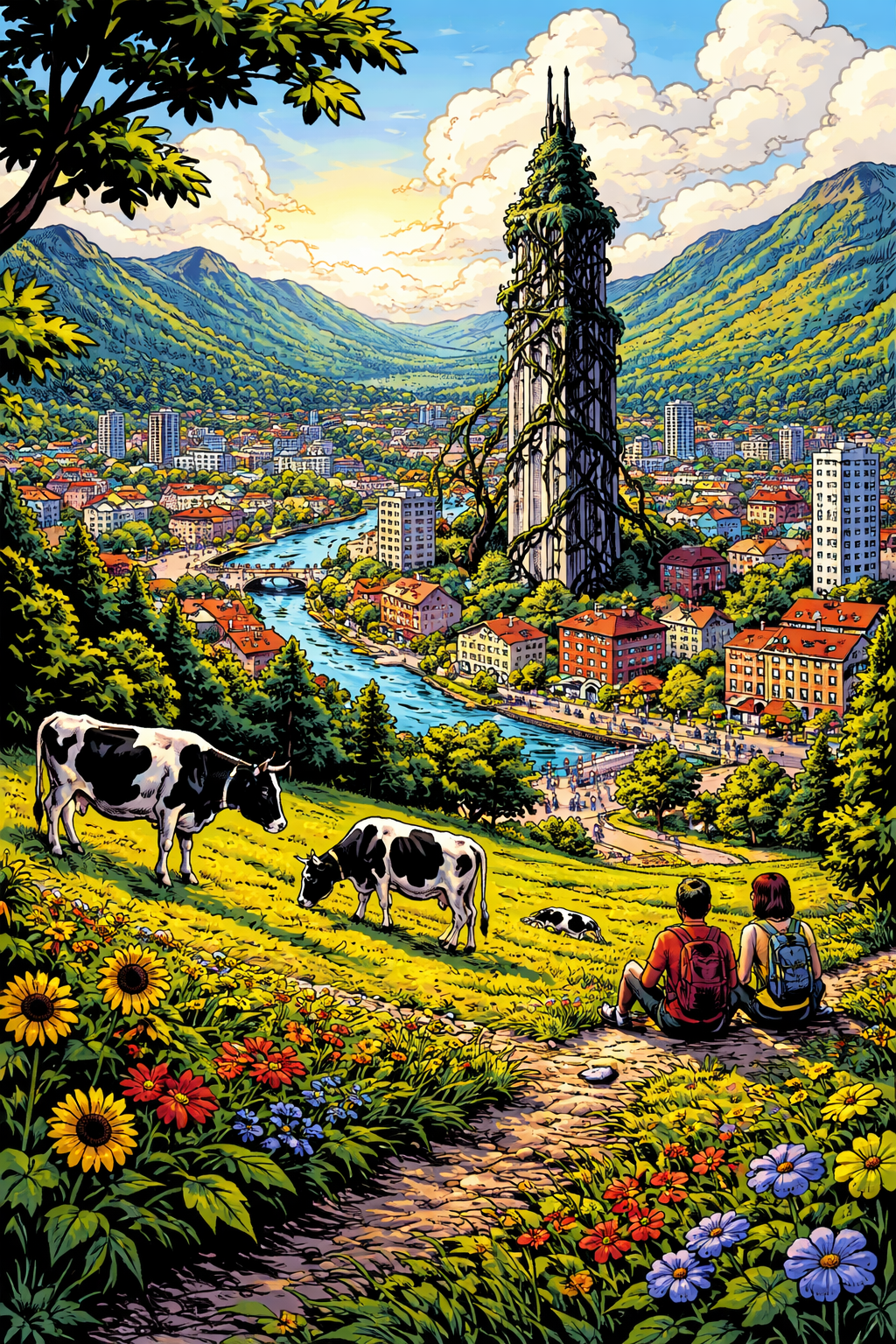
After decades of time the town grew into a city with a citadel at its center where the elites resided, individuals who had innovative ideas and silver tongues. The masses listened to them and followed their every word. The citadel was constructed to stand tall with walls higher than any other structure around. There were towers at its corners and huge windows in the residential lots. What was once a cult soon became a religion. A great church was constructed atop the citadel which was built in worship for the entity. Its influence throughout the entire city. When the executives had passed, their inheritance was given to their offspring, and they became the leaders of the church. Sacrifices became a part of the culture. When all of the nonbelievers had died out, the faithful would do anything for their god, they began an annual lottery where one individual would be chosen to sacrifice themselves to their lord. Those wealthy enough could buy their way out. As time went on, the population grew well into the millions, and one sacrifice a year was no longer producing enough resources to sustain the civilization.
More sacrifices were required, two a year, three, then four. And as they continued to make more sacrifices, the land around city rose in response. Great ridges began to grow around the city, so the leaders had the citadel built even higher to touch the sky. High bridges were built so that people get to the countryside, where the farmland was reserved. These bridges stood high above the common folk residencies, as if to disregard their existence.
Many generations later the people grew restless. Their faith began to falter and they cared little for the religion, and the deity of the entity faded. Only the guards and priests knew where the sacrifices went. And only the harvesters knew where the resources came from. The nobles stopped building for a long time, as the city was completely surrounded by high cliffs, and the stockpiles of resources were full.
Nearly a year after the last sacrifice, farmers began to worry, as their crops were no longer growing as lush and bountiful as they had been. As word got around, many people were frightened. The decision to start the sacrifices again split the city in two yet again. Many of the smartest people in the city came together to try and solve the issue, they devised a ten year plan in which most of the city was able to come to an agreement on. They would start by planting around a thousand trees near the highest concentration point of the veins. They would then sacrifice cattle every so often in order to keep the entity satisfied. Food was rationed and after many years the trees grew tall, strong, and had huge green leaves on branches the grew the ripest fruits.
It was late summer and time to see if their plan would work. On the final night the people didn’t sacrifice anything in hopes that the entity would take the trees as an offering. In the morning several of the executives and many citizens went out to check the trees. They were surprised yet relieved by what they found. The forest was baren, every tree was dead and withered, not even a single leaf left behind. Even the grass had turned black and corroded into the ground. The people believed they had appeased entity for now and that if they repeat this process they could finally live in peace. A new location was selected for the growth to allow the old one to recover, and new trees were planted. In the following months, crops grew lush again and all was at peace for a while.
On the night of the coldest day in mid-winter. The citizens of the city put wood into their fireplaces, enough to last the night. They whispered their prayers to ask the entity for peace and then bundled up for the long night. Nearing the middle of the night a quake shook the entire city. Everyone felt it and began shouting to each other about what it might mean. The quake then hit again, but this time it wasn’t coming from the ground. It came from within the city, within the walls and streets. Before even a gasp of terror, the city began to tear itself apart as black veins and tendrils burst from within the stone. They slithered their way through city like snakes and climbed the walls of the citadel like hungering vines. Those that were outside their houses tried to run, but not only where the veins faster, there were more of them. The veins cut off exits and corridors. The veins wrapped themselves to people and harvested the life from them, causing the individual to wither away. As the victims screamed from pain and agony, their skin turned gray, faces went gaunt and expressionless, until they stopped moving. The screams of an entire city filled the air. People fleeing and pushing others past to escape the monstrosity. But not even the elites, in their ivory towers, could not escape the carnage and soon met their demise, as they were trapped own hubris. Those that made it out of the city froze to death in the cold. And after what seemed like an eternity, the city fell silent. With all the life blood the entity had consumed. It began to grow the land around the city, pushing the stone and dirt. Once was high enough, the land began stretching over to bury the city. To devour the shrine to a false god.
Kory is a fourth-year student at Grand View University, studying to expand his creative skills. For this piece he wanted to try a new style of writing that didn’t revolve around specific characters. “Avarice” is about the folly of how greed destroys civilizations. Through constant experience, he tries to look for ways to improve his work.
 Mountain Jay Books