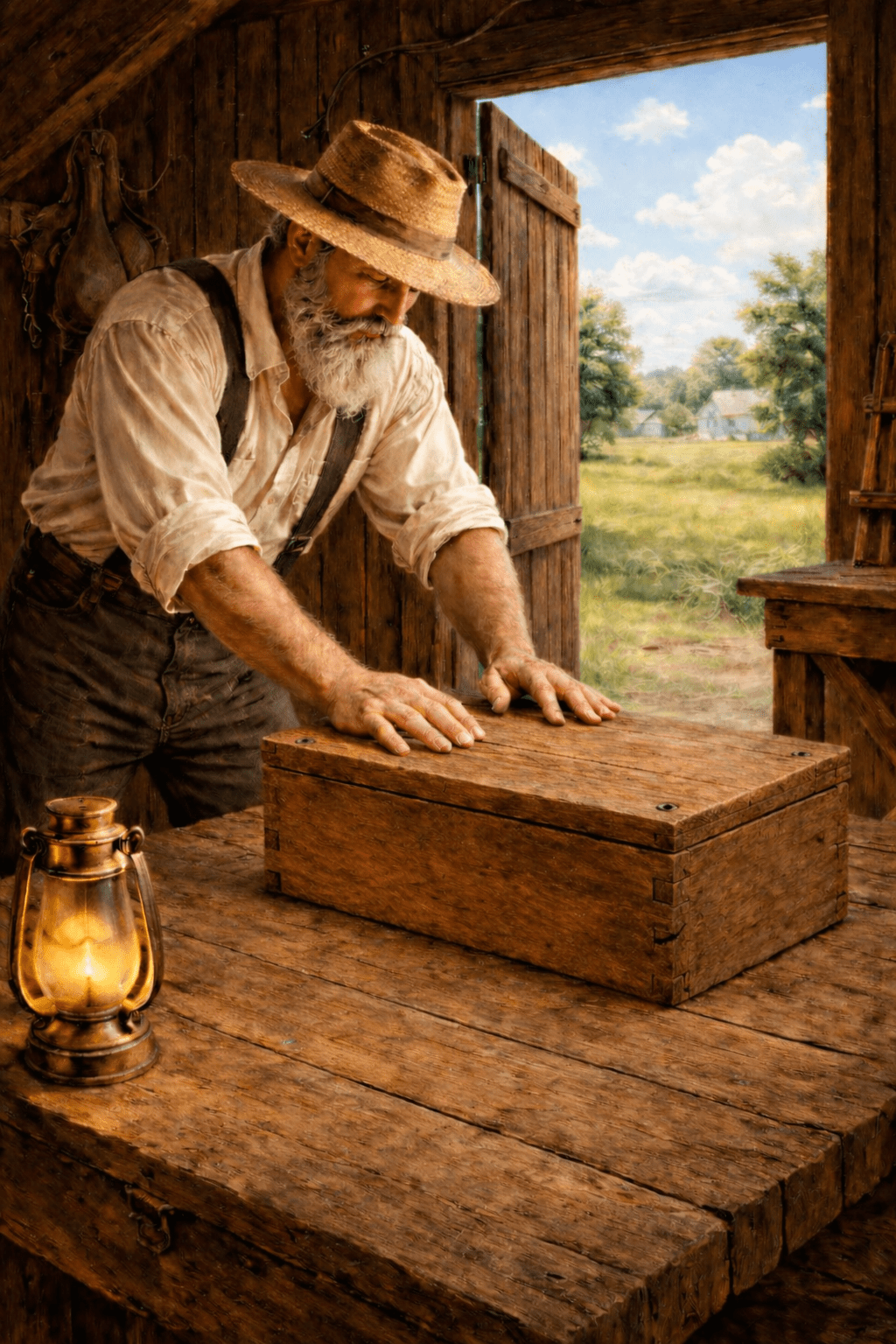
Caleb Yoder was dying.
Everyone knew about his imminent death, for everyone had witnessed his monthly, then weekly, and then daily decline due to the terrible progression of his cancer. We also knew it was probably only a matter of days – if not hours – until he passed. The whole community prayed for him, and many of the elders and others went to see him, to wish him well and – without actually saying goodbye – said their goodbyes.
We were roughly the same age, Caleb and I, and I remembered that in his youth and up into his 50s (as we are now), he stayed mostly to himself, social when needed, but always with an air of pointed secrecy. Not that this trait was altogether uncommon among us. Many here relish finding time to be alone; relish not having to share everything with the community. Even though it consisted of so many relatives and like-minded friends. But I’ll admit that I, too, did and still do enjoy and look forward to private time with things and thoughts that were mine alone.
Caleb was like that, but even a little bit more. And now he was dying surrounded by family and well-wishers.
When I got an urgent message that he wanted to see me right away, I was both surprised and curious. I pulled out our family Bible and turned to the family tree that was tucked in the front. I should have done this before, but here I was now, trying to determine exactly how (or if) I was related to him and why he wanted me for a private farewell. That’s what I thought it was for: a private farewell.
His wife, Greta, greeted me at the door. “Guder daag, Greta,” I said.
She came back with “Guder daag, Abram.”
“How is he, then? Comfortable, I hope and pray.”
Greta closed the door behind me, and we stepped into the family room. She wore a quiet sadness that I’d seen before on those about to become widows. It would be impolite to ask how she was faring.
“He moans and gasps a bit. And he prays. Overnight, he makes sounds I don’t recognize, but in the morning, he tells me he’s finding solace in prayers and in the word of the Lord, and he knows the Lord will forgive his sins yet unspoken.” She turned away, trying to keep me from seeing a tear on her cheek, and she wiped it away. “As you know, he asked for you. He says he needs your help and your counsel. Best go up to see him now, Abram. I don’t believe there’s much time left.”
Counsel? From me? I couldn’t understand why. What was special about me that I could give counsel to a man so close to death? The only other time he asked me for advice was about selling a horse to an Englischer.
“Caleb,” I said softly as I pushed the door to his room open.
He was lying flat on his back, skeletal, bald and pale, staring at the ceiling. I said his name a second time. He tried to turn his head towards me but could only shift his eyes.
“Abram,” he said in as hoarse a voice as I’d ever heard. “Denki. You came. Please, close the door.”
I did as he directed and went to the bench beside the bed. I took his hand as I sat.
“Abram,” he said again, “My end is near… and forgive me for being short. I must get this out now, while I can…I need a service from you, and I need your solemn word that it will be done.” He made as if to cough, but all that came out was a breathy wheeze. It made me think that a death rattle couldn’t be far off.
“Of course, Caleb.” I squeezed his hand tenderly to indicate that he could count on me.
“There is a box, Abram. A wooden box. Made by Samuel Stram many years ago. It is under the bench you are now sitting on.” I flinched, puzzled and surprised. “Take the box with you, and on the day after my funeral, I need you to burn it.” He wheezed again, softly. “Burn it thoroughly. Be certain that all that is left are ashes.” His rheumy eyes looked pleadingly at me. “You will do this for me…Abram?”
“If that’s what you want, of course I will, but –”
“Don’t open it and don’t let anyone else open it.” He brought forth a small cough; or rather a small throat clearing. “Especially not –” A true cough gripped him then, jerking his head forward, and I saw a small pool of blood between his lower lip and his tongue. “– Greta.”
He convulsed then in a coughing fit so violent that I shouted for his wife to come at once. She came in, barely in time to see him give her a wan smile. Then he died.
#
The tradition here among our Old Order Amish is to have the funeral and burial three days after we die. And so, Caleb Yoder’s funeral followed in that tradition.
The next day, late in the afternoon but well before sundown, I went into my pole barn at the far end of our tobacco field. There was a hollow there, about thirty feet from the back of the barn where I’d sometimes burn things that are too big for our wood-burning stove.
Caleb’s wood box sat on a table in the barn, where I’d placed it the day he died. I had cleared away the tools and swept off any dust, dirt, and wood shavings from around it. I stared at it, wondering and worrying, looking for a personal technicality. He’d told me not to open it, but – and here’s where I was trying to justify my next move – he died before I agreed not to.
What was in there? What could he have saved that was so… important? So embarrassing? So dangerous? I knew I was going to open it. I knew I was, but I felt that if I delayed long enough, I could say – even to myself – that I tried not to.
The box was made of solid pieces of knotty pine with dovetailed joints. A signature of Samuel Stram. A box like this had no need for dovetails. Half-laps or even butt joints would have served just as well, but Samuel was a stickler for perfection and appearance – even for something as utilitarian as a storage box. And that’s what I believed it was. A storage box.
I measured it. It was thirty inches long, sixteen inches high and sixteen inches deep. Hingeless, the three-quarter inch top was screwed down with six flathead brass screws. Flathead screws. Some people call them slotted heads. The only screw heads Amish carpenters of the Old Order would ever use. But I will admit… I myself have more than a few boxes of Phillips head screws. I keep them out of sight. And I use them only in projects where I’d be certain they’d never be seen.
So, I bit my tongue, closed my eyes, said a prayer in advance for forgiveness, and reached for a flat number two screwdriver and went to work.
#
I parked my dachweggeli – some of us do call it a buggy – by the front of Samuel Stram’s house and walked over to his woodshop. He stood at the door, watching me approach, and I got the strange feeling he was expecting me. He had his arms crossed over his chest and bit on a glowing corncob pipe, the smoke hovering around his gray beard. He was much older than me and though others in the community frowned over his use of tobacco, he ignored them. Old Order Amish smoked, and he wasn’t alone in this vice.
“I believe you came for this,” he said before I had a chance to give him a customary greeting. He reached back inside his shop to pull out a slab of three-quarter inch thick piece of knotty pine wood. It had two two-inch by four-inch tabs of leather tacked close to each end on the top. He handed it to me.
“It’ll fit in Caleb’s box? Like the others?” I asked.
Samual smiled. “It’s not really Caleb’s box.” He took a long draw on the pipe and slowly blew out the smoke upwards away from me. “I made the box some forty years ago for Jacob Stoltzfus. It was to be burned then. But Aaron Lantz didn’t burn it, and neither did Nicolas Hochstetler. Or Caleb Yoder.” He squinted hard at me. “And now it seems you won’t be burning it either.”
I didn’t know what to say. I felt like I’d been caught with my trousers down around my ankles, but in truth, I came here expecting that exact feeling. I continued to say nothing.
“I have two more dividers,” he said. “They’ll be here…even after I’m gone.”
I shook my head. “There won’t be any room for more dividers. What I put into the box will come up to the top.”
He harumphed. “I’m eighty-three years old, and I should probably build another box before I die. I’ll leave it here in the shop and let my great-grandson give it to whoever wants it next.”
“How much do I owe you?” I asked.
He waved away my offer. “Nothing. It’s an old piece, and it’s only old wood glued up long ago. But Abram.” He smiled widely. “When you’re on your death bed, do tell the next one to be sure to burn it…for real. It was built to be burned.”
#
Most of the items on the bottom layer of the box were totally foreign to me. I’m sure they must have meant something to Jacob Stoltzfus, whoever he was, but I didn’t recognize any of the old pictures, magazines, or toys…if they were toys. I didn’t remove any of them after I realized they were at the very bottom of the box. And I placed Samuel Stram’s divider down on top of them, holding it by the brittle leather straps.
The Aaron Lantz level held about as much mystery as the other, and so did the Nicolas Hochstetler level. I didn’t know most of the people in the photos (though this time, I figured that they were some English actors… or athletes), the books, the strange items. I reloaded everything in the same order I’d taken them out.
The items in Caleb’s level were almost all recognizable to me, because a few of them, I have to admit, I already owned and had secreted away in hiding places about the house, the pole barn, and the smokehouse. Here was Silly Putty, a Slinky, a Darth Vader Pez dispenser, a set of Pokemon trading cards, a DVD of Witness (useless, I suppose, since there was no sign of a DVD player), a signed photo of Heather Locklear, three MAD magazines, a Mickey Mouse hat, a solar powered rechargeable flashlight, a third-prize trophy for a ballroom dancing contest (when could Caleb have gotten that?), a pair of Ray Ban sunglasses, and…a photo of Caleb on the horse I once long ago helped him sell to an Englischer.
And so, it was my turn to add to the now fifth generation of this secret Burn Box.
After handling and inspecting each piece, I laid Samuel Stram’s last wood divider atop Caleb’s level and carefully added – for now – just a couple of my own things. Other pieces will follow now that I know I’m not alone in my desire for curiosities. I’m finally at ease, feeling that my lifetime of guilt has been arrested even at this stage in my life. There were others before me, and I’m pretty sure there are and will be others to come.
I took one last look at my own small collection of Star Wars Pez dispensers inside, and before screwing down the knotty pine burn box lid, I smiled down at the American Eagle advertisement of Sydney Sweeney gazing blankly up at me.
Someday this will all burn…but not today.
Vince Dowdle Jr. is the author of two books: The Philadelphia Sampler of Photographs Past and Present and Big Change Gonna Come. (Please check this one out on Amazon.) His short story, “Her Own Shin Bone,” was selected for the March 2024 issue of The Bangalore Review. Vince lives in Philadelphia, where he works – self-employed – selling and installing safety swimming pool fences (keeping small children from the natural hazards of swimming pools).

