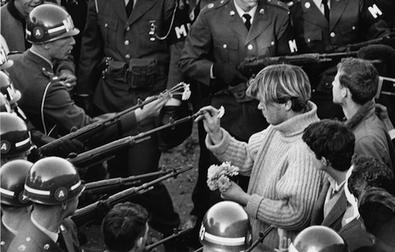
Tear gas and Mike’s flamingo pink hair were two of the things on Harold’s mind as he stepped from his car. A strong gust of unusually cold October wind swept the hat from his head. “Shit,” he said as he watched the hat tumble down the street toward the courthouse, eventually lodging in the greasy mess below a beat-up dump truck parked near a street construction site. Turning away he pulled the collar of his trench coat around his neck, buried his chin in the lining, and headed toward White’s Tavern.
The long-haired young man in the black and white photo on the front page of this morning’s newspaper was the third thing on his mind. He marveled at the young man’s serenity and focus as he carefully inserted the stem of a flower into the gun barrel of a U. S. Army M. P. near the Pentagon. “How could I miss it?” He thought.
“He should be okay in a day or two,” the improbably young emergency room doctor had said late last night between bites of a banana, which he casually ate while leaning against the wall outside the examining room. “Just make sure he uses the inhaler I gave him.” Then, as if thinking aloud, he added, “I’ve seen a couple cases like this tonight.” Mike had said very little on the ride home except “yes sir,” when Harold ordered him to go to Joe’s Barbershop before school the next morning to have his pink hair shaved off. He was gone by the time Harold left the house for work.
Steamy heat, the overpowering smell of frying bacon and stout coffee, and the masculine mumbling and clinking of silverware and ceramic of the weekday breakfast crowd greeted Harold as he shucked his coat and hung it on the crowded coat rack, thinking again of his hat. Harold could feel the men in the dining room undertake their ritual appraisal. Every bite of egg or sip of coffee, strain of muted conversation or muffled laugh at joke or story, every recounting of a son’s athletic exploits or complaint about an errant daughter or nagging wife imperceptibly slowed as each man turned his head slightly, subtly adjusted his position or, if he had a clear line of sight, simply lifted his brow, to inspect the newcomer.
The single dining room of White’s Tavern was small with a low ceiling and rows of fluorescent lights, most still working. A corner booth anchored four others angled two to a side around the walls at the far end of the room. Above two of the booths, large, fogged windows overlooking the street. A dozen or so wobbly square tables, their tubular legs dropping from beneath grooved chrome rims to the uneven tile floor, occupied the center of the room. Working men, store clerks, insurance salesmen, auto repairmen filled the straight-baked vinyl-covered chairs at the tables, atop which sat stainless steel napkin dispensers and matched pairs of smeared glass salt and pepper shakers, plates heaped with oozing eggs, sausage, greasy strips of bacon, baskets of biscuits and toast, and bowls of dark brown gravy for the table.
To the left of the door stood a bar fronted by eight stools with cracked red leather cushions that swiveled on chrome pedestals bolted to the floor. A man sat at each stool, hunched over his plate, elbows touching the man on either side, each eating in silence. When the men at the bar glanced up from their plates to sip their coffee, they could see the chaos in the kitchen through a large service window below which stood coffee machines, trays of silverware and all else a waitresses needed to assemble a breakfast or, later in the day, a blue-plate lunch. A group of young black teenagers in hairnets and stained white aprons labored over massive flat iron griddles frying eggs by the dozen to perfection among sizzling rows of bacon and link sausage and piles of greasy home fries. Carl, the proprietor, shouted instructions to the young men around an unlit cigar.
Several men nodded at Harold as he turned from the coat rack.
“Get over here boy.” The shouted greeting echoed like a pistol shot across the room of men. Hubert was comfortably ensconced in his favorite booth, right hand in full grip of a heavy, squat ceramic mug of steaming coffee, left arm draped across the back of the bench seat of worn and cracked Naugahyde. Hubert was as much a regular feature at White’s as the greasy home fries. Arriving nearly every morning shortly after opening time to spread himself out in his favorite booth, passing the morning making pronouncements and holding forth about politics and the general circumstances of the world to anyone brave enough to sit down with him or unlucky enough to occupy an adjacent table.
“Damn Boy, you look like you didn’t get lick of sleep last night,” he said as Harold approached.
“Morning Hube.” Harold slumped into the booth across the table from his friend wondering if he had taken a look at himself in the mirror this morning.
A young brunette whose name tag read April appeared at the table and filled a mug for Harold before he could get comfortable.
“Warm up Mr. Leary?” April asked Hubert with a smile revealing a set of perfect teeth far too big for her small mouth. She wore a black jumper with white blouse, the uniform Carl required of his waitresses, part of Carl’s famous “Best and Prettiest Service in Town.” One of the two huge pockets at the front of April’s apron was crammed with order pads, pens, and paper wrapped straws. The other was stuffed with a red plastic squeeze bottle of catsup and a small container of hot sauce bound for a plate of scrambled eggs at another table. The jumper fit snugly and was hemmed well above the knee. “Tight enough to show some shape and short enough to show some leg, but not like those damn miniskirts” was Carl’s prescription. The only concession to individuality Carl allowed was the floppy bow each girl wore in her hair. April had chosen a bright red and black paisley. The entire get up seemed simultaneously low class and entirely too formal for the White’s Tavern dining room.
“Love it Sweetheart,” Hubert said with a griddle-sized grin. “Tell me again which part of the Lineweaver family you hail from. Not those Mt. Clinton Lineweavers I hope.” April laughed, poured the coffee and left without answering.
“Damn Carl dresses those girls up like dolls and then tells them not to talk to anyone. What does he think we are? Bunch of Hyenas?”
“Carl’s a pretty smart guy,” Harold said squinting as he let the hot coffee scorch the back of his throat hoping it would clear his mind.
“So why the long face?”
“Tired I guess,” said Harold, adding and immediately regretting it. “Lot’s to be tired about.”
“Got that right,” said Hubert, hunkering over his coffee mug grasped in both his hands. “You see the Daily Record this morning? Front page. Can’t miss it.” Harold could not decide what surprised him more when he’d opened the newspaper before heading to work. Was it the audacity of the young protestor calmly sticking the stem of a flower into the rifle barrel of the solider outside the Pentagon Saturday night? Or was it the realization, which hit him like an unexpected blow to the gut on his drive to work, that Mike had been there, in Washington D. C. last night?
“If that kind of thing spills over into the Valley,” continued Hubert, “Harrisonburg will end up like Detroit. They sent police out to raid a Vietnam vet party and the entire city went up in flames. Looting, fire-bombing cars, people beating other people, tear gas everywhere.”
April appeared at the table to take their breakfast orders. Harold used the interruption to change the subject.
“How is Paige?”
Hubert fidgeted as he stirred a long pour of sugar from the smeared glass dispenser into his coffee. “Same. Down in the back. Still in bed.” He grimaced and avoided eye contact as he took a sip of his super-sweet brew.
Harold regretted asking about Paige. “She’s just like her mother and her sister,” was Susan’s refrain whenever Harold and his wife talked about Paige. “Her mother took to the bed before Paige left home. Her sister did the same thing once she was out of the house. Who could blame her though, having to live with Hubert. Can’t keep a job.” In the time since he and Harold had returned from the Pacific, Hubert had changed jobs almost every year. He wanted to be his own boss. To Susan, the string of failed paint stores, tasty-freeze restaurants, used car lots, and dozens of other enterprises demonstrated a lack of ambition and failure to provide for his family. But Susan could never understand the power and mystery of that impossibly hot and steamy morning on that God forsaken Pacific Island when Harold, Seabee cook third class, slopped some hot rations onto another filthy mess kit and looked up into the dirty face of his boyhood friend Marine Lance Corporal Hubert Leary. The reuniting of two poor bare-foot boys from Dayton, Virginia was a miracle in the massive chaos of world war. They had two precious days together to smoke cigarettes and talk of home. “He’s my friend Suz,” was all Harold could muster when Susan had had too much.
“Tell Paige I am thinking about her. We should get together,” said Harold.
“Yeah, we should do that,” Hubert said without conviction. “My best to Susan.”
April appeared balancing above her head a large tray loaded with plates of food which she expertly maneuvered as she placed the plates in front of the two men. She refilled their coffee mugs and quickly moved toward another table.
They sat in silence as they organized their food and sipped coffee. Normally, Harold loved the big breakfast at White’s, which he often took after having toast and coffee with Susan and Mike before he left home for work. He had little appetite today. A tornado of questions swirled his mind. “Was Mike with the flower man at the Pentagon?” “Where was the chaperone, Mr. Parker?” “Why the hair dye?” Questions that seemed unanswerable or even trite against the stark realization he had completely missed some significant transition in his son’s perspective of the world. Like the hat blown from his head that morning, it was as if Mike had suddenly and unexpectedly separated himself.
“Do you know what is going on with your kids?” Harold asked, looking across the table to his friend.
Hubert put down his fork and leaned back, rolling his eyes. “I wish. If my kids didn’t live at home, I wouldn’t have a clue what they were doing. Hubert, Jr is barely making his grades and Susie lives in some psycho world listening to that damn rock and roll music twenty-four seven. Don’t get me started on that strung-out skinny halfwit boyfriend of hers.”
“I mean, do you know what they are thinking? What’s on their mind about what is happening in the world?”
Hubert sighed and looked down at this coffee cup as if in surrender. “I haven’t really talked to my boy in a year. He is so distant. His mind is everywhere but here. What are you thinking?”
“Mike came home last night with pink hair,” Harold said, for the moment electing to omit his suspicions about the protest.
Hubert looked at Harold with a slight grin, which broke into a laugh. “Welcome to my world,” he said. Then, growing serious he said, “You and I talked about Mike’s hair one time. Remember? I told you not to let him grow it out like that. I told Junior if he is going to live in my house, he better keep his hair a decent length. By damn, he got it shaved. Looks good, like a Marine.” Hubert paused and looked at his friend. “You let Mike grow his hair down to nearly his ass and look what happens. Turns it pink.”
“It’s not down to his ass,” said Harold defensively. “I made him go down to Joe’s and get it cut off before school this morning.”
“Damn good idea.”
“He said he and his friends were just experimenting this weekend.” Harold paused and then said, “In D. C.” Hubert looked up suddenly but said nothing as each returned his attention to their food.
Harold took a bite of scrambled eggs keeping his eyes on his plate. The eggs tasted like the antiseptic of the emergency room. Mike had arrived home late, his dark hair dyed pink and complaining of nausea and shortness of breath. They did not speak on the way to the hospital and Mike insisted he see the doctor alone, leaving Harold in the waiting room with his thoughts and an elderly man huddled in the corner with a young caretaker, perhaps his daughter. Mike had been vague about the purpose of the field trip to Washington, D. C. with his political science teacher and several other students. Susan signed the slip giving him permission to miss school on Friday. “It’s a sanctioned trip,” she’d said. “Mr. Parker will be with them, and he is driving. They are staying with friends of Mr. Parker,” had been Susan’s response to his question about lodging. “Apparently, there is a big event in D.C. this weekend. No hotel rooms downtown,” she’d added. He wondered about Mike missing basketball practice on Friday but did not ask. He thought about Mr. Parker’s long hair.
Hubert broke the silence. “Have you noticed how all the punks, misfits, pacifists, and dead beats in this world have long hair,” asked Hubert. “Not to mention those limeys who think they are better than Jesus Christ. Hippies everywhere. “Good thing you nipped it in the bud with Mike.”
“You’re probably right,” Harold conceded. He’d never understood his friend’s obsession with the length of man’s hair. He and Susan noticed that Mike was letting his hair grow longer — and spending a great deal more time grooming it. His basketball coach allowed him to tie it back and didn’t seem to mind. To Harold, it seemed Mike embraced long hair as a fad more than as a political statement. He’d seen no change in his son’s behavior or outlook on life. He had plenty of friends, his grades were good, he seemed to be content and happy.
Until last night.
Maybe Hubert was right. Long hair on young men seemed to have become an essential element of today’s youthful rebellion. It was troubling to Harold that the day’s anti-war protest movement, featured each evening in the grainy black and white of network news, was so full of long hair, shaggy unkempt beards, and clothes that appeared purposely ragged. Like the photograph in today’s paper of a shaggy young man stuffing flowers into rifle barrels outside the pentagon Saturday night. Mike had been there.
“Do you think long hair on a boy is really that bad?” Asked Harold, his question a poor surrogate for the one he wanted to ask. “I mean Mike is a good kid. He just likes to wear his hair bit longer than others. He ties it up to play basketball. Coach doesn’t seem to mind.”
Hubert redirected a forkful of scrambled eggs from his lips back to his plate and looked hard at Harold. “Are you kidding? Of course there is something wrong with long hair on boys. It’s as bad as a young girl shaving her head like those weirdos at the airport.” Hubert leaned over the table bringing his face, now red as a beet, just inches from Harold’s. “It’s like they are thumbing their nose at everything you and I fought for.”
“Is protest really that bad?” Asked Harold, hoping Hubert would see the question as a point of discussion not a declaration of a position.
Hubert’s face darkened and then flushed as he stared hard across the table at Harold, as if challenging some heretofore unknown and imponderable weakness in his friend’s character. Harold was frozen by the vehemence of his friend’s attack and immobilized by his own uncertainty, his own lack of understanding of what Mike was really about. Neither moved for several minutes. Finally, Harold leaned back slowly hoping to diffuse Hubert’s anger. Hubert’s gaze flickered and softened slightly, his face, as if releasing some terrible pressure, began to slowly deflate.
Carl appeared at the booth and slid onto the bench next to Hubert, a huge mug of coffee in his hand. “You two look like you are having a real conversation,” said Carl breaking the spell.
It was Carl’s custom to tour the dining room near the end of the breakfast surge. He waved a beefy bare arm. “April Honey bring these boys a refill.”
“Big crowd this morning Carl,” said Hubert, his eyes softened but still locked on Harold. Then, pushing back into the soft bench and glancing at Carl, Hubert said, “You must be a millionaire by now as much as you charge for a strip of bacon.”
“Nobody’s going to be a millionaire if that damn Lyndon Johnson don’t get the hippies under control,” said Carl. “See the paper this morning? Kid with the flower?” Carl gulped his coffee eager to engage. “Take Jessie’s boy. Hubert, you know that boy. What’s his name?”
“Jimmy,” said Hubert.
“Yeah, take Jessie’s boy Jimmy. Damn fool boy grew his hair nearly to his ass. Had to tie it up in a bun just to go to school. Even tried to grow out a scraggly beard. Come in here for breakfast one morning and I threw his ass out on the street. Told him to get a haircut and shave if he wanted to eat in my establishment. Next thing Jessie knows that boy is down at the Mick or Mack filling his pockets full of candy bars and walking right out the front door with them. Dumb kid got just ten yards out the door before Bobby Estep caught him by the collar, dragged him back into his office and called the cops. Jessie did the right thing letting the kid spend the night in jail. Should have done the right thing before and made him show some respect by cutting his hair to a decent length. Do you know what I found out this morning?” Carl now hunkered over the table grinning at Harold and Hubert in anticipation of dropping some important news said, “I found out this morning that kid was at that protest at the Pentagon Saturday night. His uncle told me the boy got tear gassed. Should have arrested every one of those protestors. I expect the draft board will take care of that boy.”
A loud crash from somewhere deep in the kitchen pierced the comfortable murmur of the dining room. The movement of forks and mugs paused as everyone waited. “Shit.” Carl snarled as he squeezed out of the booth with surprising agility and disappeared through the swinging doors into the kitchen where his curses released the men in the dining room to continue their eating.
“Draft board. Damn right,” said Hubert as he watched Carl leave. “The Marines will cut that hair. “Harold thought of that rainy Tuesday morning so many years ago when he and Hubert took the same train out of Harrisonburg. Headed for war. Hubert to the Marines, Harold to the Navy Seabees. They wanted to go. Everyone wanted to go.
“Carl has his opinions,” observed Harold.
“I agree with him,” declared Hubert. “Damn government should crack down on these long-hair hippies. Going to ruin this country running around in the streets smoking pot and making love.” Hubert leaned back in the booth and surveyed the room. “Look at all these hard-working guys in here. They are out there making a living every day so freaky teenagers like Jessie’s boy can drive down to D. C. and trash the country. What the hell has happened to these kids?”
“Has Junior registered for the draft?” Asked Harold
“Next month. I’m going to make sure he gets down there. I don’t want any draft dodger in the house. Preacher invited one of those conscientious objectors to talk at the church last week. I damn near walked out. Wasn’t the only one. Long-haired boy who skipped the draft by joining the Brethren Volunteer Service. Can you believe it? Emptied bed pans at the old folk’s home for two years while the older Thomas boy got his ass blown to hell and back by a gook mortar. I know that Thomas boy was not worth a damn but, hell, at least he served his country. He was a Marine.”
“Junior talk to you about going to Vietnam?” Harold asked.
“Hell no. That boy is barely aware of what is going on in town much less on the other side of the world.”
Harold realized he did not know what Mike really thought about the war. It was clear after last night that he had strong feelings, feelings he had not shared with Harold. It was a month before Mike had to go register for the draft. He and Harold had never talked about it.
“There are some worrisome things going on. That’s for sure,” Harold observed. “Vietnam.” The last word, spoken as a thought rather than a response, slipped out before Harold could stop it. Hubert’s views about the war in Southeast Asia were well known.
“You want to live in communism?” Hubert’s color rose again. “We did our part. It is time for this generation to do their part. Country is important.”
“Country is important. That’s for sure,” said Harold to his coffee, not wanting to engage his friend again. Then, in a whisper, “I wonder what Rosenberg would think about all this?
Harold’s words fell between them like a stone into still water. Memories, long buried, rippled with a troubling symmetry into the space between them. Hubert stared at his hands. In their booth the sounds and smells of the busy morning dining room were replaced by the hot and humid memories of those two days on that stinking Island in the Pacific. What a gift. Seventy-two hours dreaming of the smells of the beloved Shenandoah Valley, allowing themselves to feel the afternoon breezes and early morning chill of their farms, dangerously allowing for a brief time detailed memories of those they left behind. And the sharing. Harold’s exotic friend Rosenberg from New York City who having never lifted a hammer or turned a screw could not believe his luck at being drafted into the Seabees. Someone snapped a photo of the three of them just moments before Hubert was to ship out. Rosenberg, shirtless, dog tags dangling at his chest, mop hair dark-eyed smile looking right into the camera, his arms around the neck of his two new country friends. The Jap sniper chose. Rosenberg. Shot dead right between Harold and Hubert.
There was never a time when Harold and Hubert were together, they did not think of Rosenberg. There was never a time either of them mentioned it. It was as if now Harold had suddenly laid that photo on the table and shoved it toward his friend, forcing him to look. He could not believe his own cruelty. “I am so sorry,” he whispered. “I am so sorry.”
Hubert sighed deeply and shook his head. “I guess he would wonder about all this hair.” He slid slowly out of the booth and stood up, stretching the stiffness out of his back. “Got to get a move on my friend.”
Harold watched as Hubert worked each table as he left the Tavern. There seemed to be no one he did not know.
Harold caught April’s eye, motioned for more coffee, slumped down into the booth and closed his eyes. He thought about Mike, pink hair, tear gas, and the young man with the flower. He wondered if Mike was embarrassed about showing up for school with a shaved head. He thought about war, his brief time with Hubert in the Pacific, Rosenberg, the pure hell of it all. And they were so young. He had the photograph. He imagined Mike in the middle of that happy trio. He thought about Vietnam and wondered why he and Mike had never really talked about it.
He took a last gulp of coffee and glanced at this watch. He could get to the school in time to spring Mike from his first period class. They would take a drive up to Winchester for the day.
Gary Miller is a retired university president (fifteen years) and faculty member with roots in the Shenandoah Valley of Virginia. He has degrees from The College of William and Mary (BA, MA) and Mississippi State University (Ph.D.) and has published widely in the biological and ecological literature fields (including one book). He has written short stories most of his life and is now exploring his potential in that area.

