Bring something to the table. It was the last line that he read before he finished the chapter and closed that book, which was an English translation of a Persian fable.
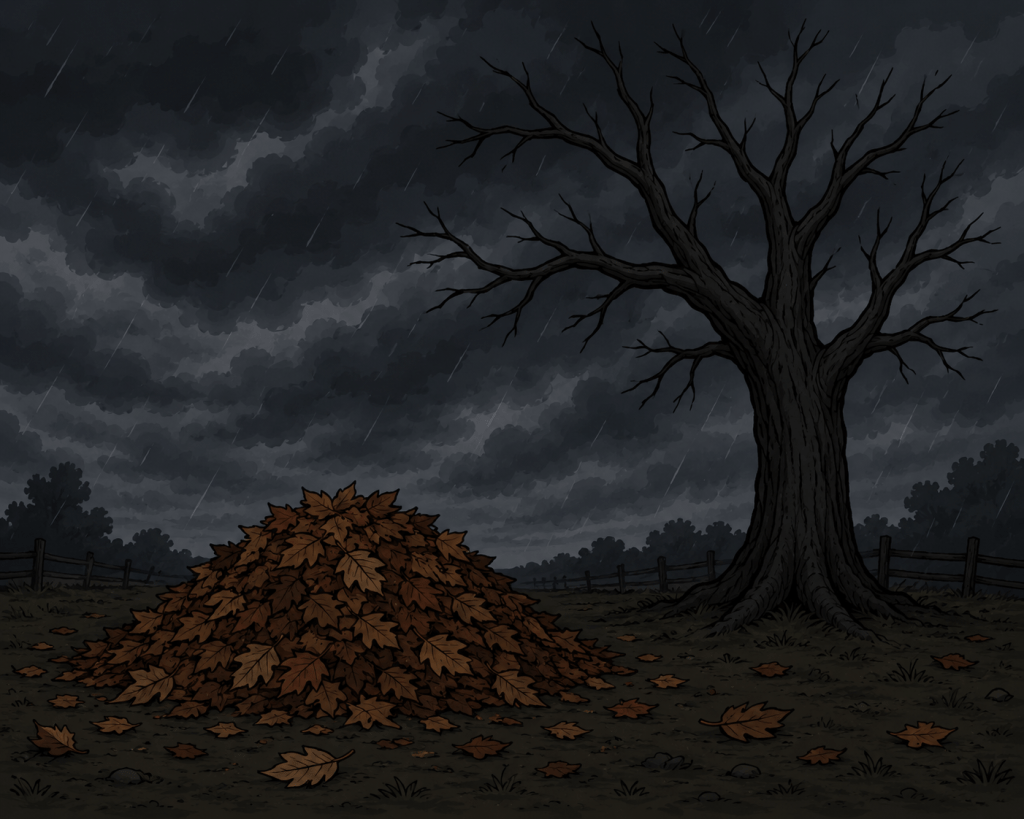
Ever since morning, there was something in the air that was quixotic but beckoned us to venture out instinctively. The dead body was found under the leaves, and the finger was pointing to a leafless tree. Obviously, the autumn had taken away a lot, and now that the wind was much more ferocious, there was a hidden giant inside it, constantly lashing the trunks and the black branches. It was not easy to find one’s way out of it, but on the trail, there was a squirrel constantly skittering as if indicating a place where there might be a cabin, a cave, or perhaps an underground bunker, or a hollow trunk of a tree.
But these were all speculations and initiations of something that was yet to form a shape. And by the way, this morning, when the old woman who lived close by in the shaded woods came out of her house, she threw the grains and the broken bits of rice to the birds, who also begin their day like an actor sets foot on the stage in search of living and mating. But it was winter. The companionship in winter becomes a question of whether we should initiate or not, whether we should embrace or not, because it’s the embrace that takes us to bed, but often the beds are cold, and the sheets are also icy, and the hearts are too frigid. So, we can postpone this genesis of our erotic first-cause. The morning brought a lot of gossip to the neighborhood. The sole siren of the police car rattled the poise.
The old woman lived in this house for more than three decades. Her children were in another part of the world. A ramshackle body, she was too old to travel, but at the same time, her love for the place remained a preamble to her life. But that prelude to her life’s story was not known to everyone in the village. So, her loneliness was the first chapter. After her sons left her every morning, she used to come out. Consistent rains bleached the chairs in the veranda. The electric light was falling from the roof, but inside her house, the kitchen was still in a workable shape. But the first food that she cooked, the first conversation people had, and the first squabble they had are still there in the air of the kitchen. Meanwhile, the birds used to peck at the window, sending messages that their morning feed was delayed.
They came out of the car and started combing the area. Rumpled, sweat-stained, scuffed collars, the cops looked overstretched. It was so usual for them to handle dead bodies like words scattered here and there, and in between comes a moment when a word, like a leaf, falls, and the passersby stop, stare, and move on. In the beginning, an unburied human carcass was fine if laid naked, but that wretched creature of a crow digging out the earth made them learn to deposit detritus. The story took a turn, and laws were enacted to allow for a sophisticated ending. But sometimes dead bodies are not found. There must have been times on earth when the dead bodies and funerary rites were not a custom, crematories and cemeteries did not exist. The Iranian Zoroastrian gave up the bodies to vultures to feed on, to take away the pollution that raised the incarcerated soul, the flesh eaten by the wheezing creature; a ritual that purified, perhaps eternalized, the dying, so began the conflict between the body and soul.
“The weather is too random this time of the year, and there seems to be no end to it.”
The crooner of the village himself belonged to a medieval clan of dervishes who wandered from village to village and, like mendicant beggars, stopped at doors to beg, then returned to their cloisters reciting verses from the holy text. But the profession he had chosen was based upon logic and the ability to scan even the smallest details in a split second. This kind of urgency cannot easily match the prolonged distractions mystics often survive.
He had a friend who had read the esoteric manuscripts and used to practice meditation in the evenings in his hut, tucked behind a small mound. The air around was dense, cryptic, plunged in arcane tones. He would come out only for parsimonious food. Sparing time, the crooner would sit with that friend, who often told him things that had no rational basis. For example, he once said that while meditating, he saw a beautiful female spirit dressed entirely in white, but it metamorphosed into an angel. Because this man, a kind of meditator, was in love with a woman, his spiritual experiences were imbued with a feminine halo.
In the end, he would come up with certain stories crooners could hardly believe, and yet they carried a tinge of fear, the kind of fear that comes to us when we wonder what if we are all wrong about human existence, and what if there is a parallel universe. What if we have been introduced to a faulty premise? “A crooner falls back on a backup plan”. He had a heart-to-heart conversation with his teacher at the academy where he was initiated.
There is always a chance of seeing reality from a divisive perspective, whereas we are instructed to rely on one faculty at the cost of all the others. In this way, whenever the crooner encountered a dead body, he also thought about an alternative plan, another course to reach out to the mysteries that often surround murders. There is no way you can stop people from killing, but there are ways to stop them from thinking about killing.
This friend, a seer with a beard and all trappings of some monastic order, paved the way for reflection. For a crooner who sees blood and severed limbs to know that the human body is not the only reality was a needful thing. Reality is a bias. Why is an investigation reserved for a body only?
“There are beginnings, but the end is not in our control.”
“Are you referring to something historical?”
“No, I am referring to something very subjective and local.”
“There were three men in the village, and they all wanted to cultivate a field.”
“But in the end, they failed to cultivate the field because the rains came untimely.”
“The men from the city responsible for seed production and distribution, and the people who were responsible for evaluating the fertility of the soil, came many times.”
“But every time it was the flood or the unexpected rain that destroyed the whole scheme of things.”
“So, what is your opinion about clouds?”
“How do they come into being?”
“Well, this is a philosophical question.”
“I think that we need to consult an expert on that.”
“Oh, we don’t have big men living here.”
“But everyone does a little bit of philosophy.”
“If you advocate something, if you initiate something, then you are a philosopher.”
“But that old lady we met on the road was mostly averse to words.”
“She had wrinkles on her face, which made me think about maps.”
“That’s how the maps came into being?”
“Who were the first people who actually were the cartographers of planets?”
“The hunter-gatherers or the colonial explorers?”
“So there is always a chance that we are unable to go into the genealogy of these people who traveled the earth and traversed the mountains.”
“But the old woman was simply nostalgic about her sons’ absence.”
“She had often talked about it to me, although it was not her way.”
“So it means that one day a child learns to speak and a mother becomes silent, and another day the child learns to leave and the mother begins to muse over his absence.”
It was those days when there was no work in the village, and the people had no choice but to leave in search of a better life. The old woman’s three sons, who wanted to make quick money, left the place. And those were the days when there were no telephone lines, and even a letter used to arrive only after a week. But there were many other ways of missing someone and loving someone, and the old woman, being a mother, had the instinctive knowledge that her sons were either in trouble or prospering according to their plans. Yet physical reunion was impossible because she had no resources to travel to the big city, where there were trams and giant glass structures.
She often thought about the place where she was born and how it had possessed her soul. Initially, it was very difficult for her to manage the memory of her children’s absence, but as time passed, she learned from the birds that they migrate without fuss. She would watch while feeding them, and when a bigger bird arrived, others flew away; the cluster would find another tree, and then, from one tree to another, they moved on to other places. So, there is no way you can stop these birds from changing their appointed places. This idea that one cannot simply sit or remain in one place was something the old woman had learned.
The anthropological versions of migration are varied and merit consideration, but it is understood that one cannot live in one place forever. Therefore, this imaginary sojourn, this chimerical flight, often the propulsion of imagination, continues to haunt people who are either forced to live alone or who choose to live alone. “One is born on earth and is taken by the earth”. Seems an oxymoronic exception, a wandering shaman once confided to her. Ever since, she peeped out of the window to find that the shadow of ancient wisdom was lost. People were catching up on screens, but she was too old for the technology. Her eldest son sent her a gadget. She looked at it like a child looking at a toy, then smirked and thought about days when she used to go to the telegram office to send urgent messages to her brother, who had a horde of land near the River Ashanti, where primitive species of birds, even an albatross, were seen gallivanting over the horizons perforated by airplanes. The fear of living close to the water is like a modern aircraft tumbling over the airstrip.
The old woman used to go out to the market, where she bought fresh fish, and on the chopping board, meticulously removed the fins. This process of removing the fins from the fish’s body was very much like the dead body being given a crematory bath before it was either buried or burned. Bears gulped down fish. There must have been times on Earth when human beings had done the same. Civilization introduced cutlery. In the long run, weapons of mutual destruction.
Time and again, she visualized the rituals of burial and of birth, because a woman of her age had ample memory of giving birth and witnessing funerals. There was no need for invention when there was so much in her mind that needed to be systematically drawn out.
But lacking company except for the birds, she had no choice but to have quick conversations with the crooners and the constables who would cordon off the area whenever there was news of a dead body. Therefore, in the end, it was impossible for her not to speak about the past she had kept inside her like a deposit. And every time a shred of memory fell, it made her look in different directions, as the valley in which her small house was perched was surrounded by monstrous mountains. The inability to transcend these mountains, which looked like gods after sunset, cannot be marked in any concrete way.
Therefore, occasional monologues with passersby, with an animal, with any individual, brought her back to life, and in return brought the hope that one day she would be able to cross the borderline and meet someone who could at least tell her that the world was changing, and that she, too, should change.
The dead body was now sent to the morgue in the city, and the forensic examination was already underway. Meanwhile, some curious people in the village approached the crooner and asked him about the prospects of finding the murderer. It is perhaps the kind of question an investigator often encounters and tarries because there is no perfect way to find a murderer. There is a widely held belief that a murderer leaves his footprints.
On that day, the rain from the previous night had destroyed any chance of finding footprints and other traces. However, there was still a strong likelihood that they would reach the bottom of this murder. The old woman also inquired about it in her own way and was constantly thinking about her sons’ safety in the city, where crime was rampant, where hit-and-run incidents were frequent, and where people were often killed in brutal ways. Thus, the safety of living away from the city and the vulnerability of living in the village introduced her to the loneliness of imagination.
Ever since she began waiting for her sons, there had been quite a few murders. So, one could say that the pandemic of killing cannot be controlled. However, it is a blessing that we have scientific inquiry, as human history has often been undercut by superstition and blind belief. Ever since the earth witnessed its first human dead body, there must have been a knocking on the door of human consciousness, a desire to find a way out, to discover who has stolen from us the chance of living on this planet in perfect security. There is no way we can do away with the contingency plans the universe has imposed upon us.
The crooner, who has lived in this village for over ten years, has seen dead bodies before, but it becomes nearly impossible to speak about a body whose face has been demolished, not by nature, but by human hands. Therefore, an air of mystery lurks around this dead body, and the people who talk about it make it sound like a story that has no resolution.
And so, the occasional wanderer, that bedraggled shaman who has the habit of leaving behind a single sentence for people to muse over, became both a suspect and, at the same time, someone who might solve the mystery. For the police often approach those who claim to possess unconventional methods of uncovering mysteries, which in this case once again center on a dead body. Thus, ancient wisdom and modern confidence begin to mingle.
“We hope that we will reach a more objective resolution.”
“Yet at the same time, the consequences of leaving no marks upon the dead body were a tad unbelievable.” The crooner talked to the hierarchy in an icy tone.
In vacant hours, he contemplated that “even a bird that takes flight, perches on another tree, and then leaves for yet another bush or mound, resembles an intruder, a mysterious intruder whose destination cannot be determined”. This was his cognitive cartography, his booby-trap to capture the murderer.
Flashback is another way of living with one’s job. Every epoch keeps parchments, palimpsests, files, dossiers, and microchips of the carnalities and carnages of the kings and their entourage. When alone in his office, he used to reflect on the history of his profession. He had a friend in a European country where he once travelled for training in homicidal units. That inspector was a homicide detective and professional to the cynical extent. The inspector’s name still lingered in his mind. He seemed like someone from a lost tribe of the Germanic races. He had inherited a wildness slightly refined by the procedural protocols. The atavistic urge to settle scores was very much there.
That Inspector from the European metropolis had a good education and a steady character. Yet he became deeply obsessed with the investigation of the murder of that seven-year-old girl. He was completely consumed by the case, by the forensic materials, the files, the tips, the clues, and every possible shred of evidence he could compile. After seven years of relentless pursuit, he was able to apprehend the killer, a man with a documented history of child abuse.
Now the story may appear common because we often say that those who are abused go on to abuse others. But sometimes we construct such explanations too quickly. We want to recuse the offender, offering him the nuances of law, the concubine that pampers the powerful. When the tests and investigations revealed that the man had no personal history of sexual abuse, it became clear that he was an offender in the truest sense of the word, someone who derived a perverse pleasure from dominating his victims, especially young girls.
The inspector brought him to justice, but in doing so, he lost his marriage. He had a daughter named Isabella. Now, when he tries to meet Isabella, the mother attempts to bar their meetings because she believes the father has gone mad. And perhaps he has, in some sense. Yet within this madness, there was a human element. In his obsession with de-fossilizing the truth, excavating it from layers of deception and silence, the man had turned himself into a statue of austere spirituality.
Retired, pensioned, he lived alone like a modern-day Sisyphus, counting on the cyclical memories pivoted on the girl’s skeleton he dug out, his daughter’s apathy, inculcated into her by her mother. In many ways, the inspector was the redacted version of the old woman from the valley, waiting and peeping out of their life’s windows. The inspector’s father gave his son a taste of noir and mystery, bringing him Sherlock Holmes and Agatha Christie. That fictional dagger-and-cloak opens the door to the strangled, garroted, decapitated, burnt, pierced, stabbed, and dismembered. No one squirms watching over Greek thespians performing gladiatorial gymnastics and gods gleefully joining the spectacle of gory dance on Bachian shrines.
Last night, heavy rains had left the trails and the ruts sloshing with water. And the nocturnal animals in their predatory hunt had also plunged into them. At certain places, the water had receded, but the path on which the dead body was found was very clear. It was like a perpetual mark on the village’s face where the murderers were few and far between. On the routine patrol, the crooner reached the site for his solo investigation of the area because when you are alone on the crime scene, you are with a ghost that speaks to you and sends you messages that may help you piece together the clues. And in this way, the crooner often finds solace, at least in capturing an imaginary murderer whose face is still vague but who’s lurking nearby.
There were frogs in the water, which meant that the water had carried them overnight, and they were not croaking. Similarly, there were birds on the trees watching the crooner, and the crooner was giving them a good watch. The villagers love him because he has been very intimate with them and has tried to keep the community under the feeling that nothing wrong would happen. And if something wrong happens, he would protect them like a biblical patriarch. His presence carried an unpolished candor that made even the most troubled villagers feel an extra sense of safety.
Near that path was a barbed wire fence and a small flume of water, and across the viaduct was the house of the old woman. She had been watching the crooner from her window, and she couldn’t help suppressing the memory of her eldest son, Aadam, who had this habit of peeping from the window when he was a boy and had a speck of anxiety that there might be someone outside who might invade their home while their father was away. After Aadam had left, the old woman had replaced the position and had been constantly watching from the window, the crooner peering at the wet earth with a frugal stare.
“Any clues?”
“Not yet. We are still working on it”.
“But I have begun to feel that this time it is much more difficult to get to the bottom of the murderer”.
“When Yousef was seven years old, I told him that the world outside is not safe, but his father had great confidence in him.”
“Yousef always played near the dark well, plunging his head in it to hear the echoes while his brothers watched him from a distance.”
“Yousef was my second son, in the middle, and obviously, he was the most beautiful.”
“Last year, I received a letter from him. Ever since, he hasn’t sent me anything, and you know I cannot help with this technology. But I believe that absence is one way of presence.”
“Oh, you are a very optimistic woman. And I have also met Yousef. Out of the three, the most handsome and yet the most innocent”.
“It is the innocent who are often trapped in this world.”
“But if there is a lurking spirit that controls your destiny, you do not lose your path.”
“David is also very propitious”.
“He’s not like average boys. He loves women and wants plenty of them. And plenty of children.”
“God launched the sperm and instructed it to reach until there was nothing.”
“He will keep the family tree growing”.
“Thank you very much for the cup of tea. I felt the aroma of the cardamom, that tea our mountains have bred, and the smoke that has come out of the hut has always made this village a paradise of its own.”
“But it is so painful that in the last three years we have had three murders, and this is perhaps the most difficult one I am finding, because there is no clue.”
“Last night, somebody told me that the shaman also passed that path.”
“He stopped there and tapped the earth with his club, and there was his dog with him”.
“ I have read about the story of the dog in the holy text”.
“That dog protected the cavemen.”
“God also loves dogs .”
“Like me, they are custodial’.
“We may think that the dogs are bad, but we know that apart from being faithful, they are always there.”
The shaman always left something for the old women to cogitate. She was not interested in telephones, cars, appliances, or gadgets. But she needed fire to cook. The poaching was out of control. Bus drivers in the capital went on strike to protest fuel prices shooting up. No surprise, the coroner needed technology, the digital forensic tools for extracting data from phones, computers, or storage devices. Some villagers were already using these gadgets; the old woman was an exception. At his office, he had some equipment, but it was limited; so, first things first, to lay the groundwork, he had to send the collected data to the most sophisticated lab in the nearest city.
These days, people from the city were installing digital cameras, yet the village had none. Neither did they have all the evidence markers or measuring tools. Still, he had enough equipment to cordon off the crime scene. At the station, they had gloves, masks, and protective suits, as well as sterile swabs, collection kits, evidence bags, containers, and seals, along with vacuum and tape lift kits. But they did not have a DNA analysis system, fingerprint scanners, or toxicology equipment. He knew that only with these tools would their department reach any solid conclusions. Until then, he was only relying on his gut instinct.
The old woman advised him to take counsel from the shaman, a liminal figure, both suspect and rescuer. A shaman scries, throws bones, and interprets omens; their forensics are completely otherworldly. While the coroner mentally straddled the line between fact and fiction, an uncanny thought struck him: this time, the dead body was completely covered in leaves. When they removed the leaves, the face was unrecognizable. The size and frame of the body recovered indicated it was not an adult, but the gender remained unclear. He was still waiting for evidence.
One might note that the coroner did not reveal the body before placing it in the bag. Had he done so, identification might have been possible. It would have spread in the village like a virus. He wanted to keep it secret, perhaps fearing a backlash. But since he was close to the villagers, there was little chance of a riot in this peaceful village. They all used to meet in the central market, still untinged by the monstrous materiality. Trust drove them. Everyone waited anxiously for the reports.
One day, a middle-aged, cuddlier woman named Huma came to the crooner’s station. She was the governess for a wealthy man in the neighboring village and had to stay away from home for weeks, leaving her daughter, Ferdows. Huma was long abandoned by her drunken husband, who had been visiting the brothels. Ferdows was a giggling girl who loved playing in the fields. She also had a pet parrot, Tuti, which had a habit of mimicking everything it heard, effectively keeping an archive of the events in the house. But the parrot also had mood swings. When it went silent, the house felt utterly like a graveyard. A little doubt, Ferdows had a liking for the shaman, the silent man. Huma left her daughter to Tuti and besought the vagrant shaman to report on her daughter as he moved through the chain of small villages, pausing at each outpost in the valley. The wanderers were entrusted with the charge of protecting the housed.
Ferdows had been missing for two weeks. In that time, two rains had fallen, and the old woman had stepped outside her home only twice. It was just a coincidence; otherwise, she had her whims and had always sought the good in the open air. But these days, she was more worried, for the murder had occurred, and every time she thought about the murderer, she also worried about her sons’ safety, who lived in a more vulnerable world.
The shaman had not visited in over two weeks. A shaman is a progenitor of vagrant souls; even his heartbeat is peripatetic. Earlier, the shaman would pass along the trail near the old woman’s house at least once every two weeks. But his sudden, prolonged disappearance stirred suspicion that he might have been behind the incident. Although shamans are mystics, they are also healers, the rescuers. Yet in these times, the healers seemed to have become torturers. Still, it was a far cry from certainty. Why would a shaman, with a dog, a club, and a pouch, murder someone? These were all speculations.
The coroner was growing restless. Yet there was one piece of evidence, one witness, odd though it was, the mixed-feathers parrot Tuti. The shaman and the parrot had met once when the shaman came to watch Ferdows playing. A subtle glance was exchanged between the shaman and Ferdows, and the shaman laughed heartily. The parrot witnessed it. A shaman vows celibacy of words. They are creatures of silence, and it gives them an otherworldly character. They appear as quietly as rain or clouds, like organisms that live in hibernation or in the basement of human imagination.
The parrot saw the shaman enter the courtyard, but since the shaman uttered no word, how could the parrot repeat his exotic silence? His dog had also stopped growling. Therefore, even if the shaman had harmed Ferdows, there was no evidence. Apart from that, there was no concrete proof implicating him.
The coroner conceived other possibilities. The old woman had a brother who cultivated land near the river, had altercations with the landlord, and was once a fringe group that sabotaged railway lines during the revolution. But those had been productive activities, not acts of betrayal. This witness was a midget.
When the reports finally arrived, it was confirmed that the body was that of a child. Interestingly, it was the first murder of a child in two decades, and even more painfully, it was a girl. The village was devastated. It was established that the victim was Ferdows. But the murderer remained unknown, for the reports were inconclusive, filled with ifs and buts. The coroner was exhausted, consumed by sleepless nights.
One promising fact was that the coroner was single. In his forties, he had never pursued love or sought a companion, like his inspector friend in Europe. There was no chance of distraction or madness, yet the unresolved case threatened to leave an indelible abrasion, abstract in form, one from which he might never recover. The old woman, too, had never healed from the absence hovering over her sons. Though they were gone, their memories hissed on her from a distance.
Life, it seemed, was entering its first strange page. It was not written in any tablet of destiny that everything would be clear. The beginning of the cosmos itself is a mystery. We continually negate and accept this mystery prowling our forests and cities. The coroner, too, was left with no hope except to maintain a middle path, believing that one day he might catch the murderer, still at large, while the shaman was also missing. Yet shamans, if they are genuine and not charlatans, always reappear. Sometimes it takes longer.
One morning, the old woman decided to cross the watercourse to reach the market to buy groceries. There, in the middle of the square, she met the coroner and Ferdows’ disheveled mother. They met as if the Sphinx had arranged it, yet they chose not to speak of the tragedy. One could say that this silent meeting of the three people in the village square was one of the strongest, most mournful moments in village life. They were introduced to the power of mute wailing over a child’s death. Wordless, bowed-head, a ceremony was initiated.
Rizwan Akhtar is an internationally published poet whose first poetry collection, Lahore, I am Coming, was published in 2017 by Punjab University Press. His poems have appeared in prestigious international journals across North America, Europe, India, Australia, and New Zealand, as well as in several English-language international anthologies. In addition to poetry, Rizwan has published short fiction. He has also written and published flash fiction. Rizwan Akhtar has translated Urdu short stories and poems into English and contributes to the New International for book reviews and literary journalism. An accomplished academic, Rizwan earned his PhD in Postcolonial Literature from the University of Essex, UK. His scholarly work spans a wide range of fields, including postcolonial poetics, South Asian feminism, adaptation studies, crime fiction, Sufism, and modernist aesthetics. He has travelled extensively and has participated in international conferences across Europe and North America.

