The garage door was raised and the boy and his mother could see the man looking toward the road. They watched him tilt his head and squint at the sky. The skin was flushed around his tightened lips and a dark substance spotted his tan khakis and sleeves of a fraying sweatshirt. As they pulled into the driveway a dead deer hanging by the neck revealed itself in the deeper shadows.
Caleb got out of the car and approached his father. He leaned to his right and took in the animal. The man crossed his arms and eyed his son, trying to gauge his reaction, the boy’s face expressionless. What Caleb felt was more curiosity, perhaps disbelief at seeing a dead thing, his first. For Caleb, it was something familiar reduced to a husk of hardened flesh, now hanging from the ceiling, unmoving.
“Go help your mom with the groceries,” his father said.
It was early and cold and the sun had not yet risen above the treetops. Calls from an owl could still be heard. Caleb returned to his mother and helped her by trying to carry the paper bags in either arm. They were too heavy, though, and not wanting to spill the groceries in front of his father he lowered both to the ground, then chose one to take into the house.
As he walked through the garage he passed by the deer, little drops of blood having spotted the ground. He had seen his father stare at him, and even then, Caleb knew he was waiting for him to get afraid. Deep in his gut was a newfound determination to not reveal any emotion.
The deer had no antlers, and the pinkish tongue poked through the narrow muzzle. The body had been hollowed out, the crimson grooves in the chest cavity showing the outline of bones. The glassy dark eyes caught shards of fluorescent light, the fur thick and worn—evidence of swift sprints through the deep parts of the woods.
When he watched the herd of deer from his bedroom window, he noticed that any flicker of sound disturbing their level of comfort caused them to break for the shadowy seclusion of the woods and safety. Now one of them was swaying like the pendulum of the clock that hung in their family room.
Caleb walked into the house and set the bag down in the middle of the kitchen floor. He retraced his steps for the other one, making a point not to look at the deer straight away, more out of the corner of his eye, trying to etch each detail into his simple mind.
“Hurry up, you’re going to help me,” his father said.
“William.”
Caleb’s mother stood behind the man. She stared at Caleb holding the bag of groceries, her thin lips pressed together, a serious mouth, cheeks pink from the morning frost. His father glanced over his shoulder, waiting for her to speak again. “Not today, William. Let him go inside. It’s too cold out today,” his mother said, low enough for her to believe Caleb hadn’t heard from the doorway, an effort at concealing her growing discomfort. “I don’t want him to get scared at this. Maybe next time, William,” she said, a hint of finality to her voice. Caleb knew that tone.
His father didn’t answer right way, staring at Caleb as if appraising his worthiness, whether he should offer him a reprieve so he could go inside where it was warm. Before turning and facing the woman, a twitch of a grin rearranged the right side of his face, a slyness Caleb didn’t know his father was capable of expressing. “He’ll by fine, Audrey,” he answered, a staccato reply used to overrule and control the situation. “I’ve done the worst of it anyway so all we got left to do is skin it.” His mother said nothing, no argument, her legs stationary, her growing silence enough of a rebuttal. She let him continue, granting him his final say. “Besides, I need his help. He’ll be alright,” his father said, flatly. “He’ll be alright.”
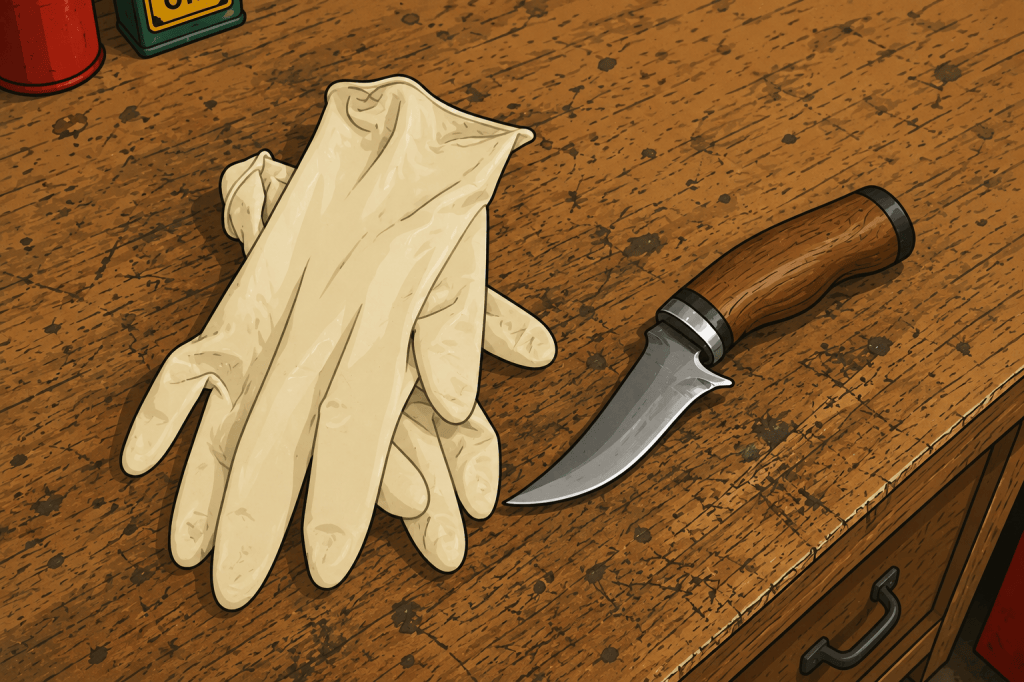
She searched the archives of her mind and tried to summon any of the various recriminations from more than twenty years of marriage, ones that might negate his plans, saying nothing instead, letting the inevitable direction of the day commence toward an inevitable outcome. Her final action before leaving the scene was to lift her chin slightly and add a curt ending. “Fine,” she said before walking past William. Without looking at Caleb she said, “Help your dad,” and entered the house and softly shut the door. When she was gone his father said, “Put on those gloves,” and pointed to a pair lying in front of a toolbox. “They’re latex so be careful and don’t tear them.”
Caleb did as he was told. He bent down and took up the gloves and put them on, wondering to himself about the chalky residue that covered the surface.
He watched his father pick up a knife that was about five inches in length and rub it at an angle against a cylindrical piece of steel. It sounded like water running over the smooth stones that peaked out of the surface of the creek in the backyard. Caleb believed the sound of that tinny scrape would remain forever—back and forth, the flexing of his father’s exposed forearms as he sharpened the knife for the cutting of the deer, the skinning. Caleb watched and admired the precision of his father’s hands. The boy waited for him to finish.
And it was only when he finally spoke that he could feel a rising panic as he watched his father start to cut around the deer’s thick neck. About six inches below the incision, Caleb could see the ragged flesh, the landscape of fur in disarray, hairs protruding in different directions—the entry wound, the death shot.
He was afraid he would disappoint his father, and tears would not be a salvation for avoidance. The chilliness of the garage would be the altar for a baptism, an initiation into whatever he was born to learn, or the sight of his destruction, the man a witness to his failing.
“Come over here and stand,” he said, pointing to a spot that gave him an up-close view of the gutted animal. “I need you to hold the front hooves so the body doesn’t turn.” Caleb swallowed and tried to determine if what he was smelling was the decaying flesh of the deer or just the bad taste in his mouth that had escaped through his lips. “Do you understand?” his father asked, looking at him, the cutting knife in his right hand. Caleb watched his father, the crooked bottoms of his teeth, the red of his cheeks. He didn’t look angry, more determined to get on with what needed to be done, to finish the skinning in time for lunch and afternoon football.
Caleb took hold of the hooves. Coarse fur, stiffened bones, he kept his eyes on his father as he continued with the long cut around the neck, around and under the muzzle. He saw the incision spreading, the rippling flesh, and how the skin started to fold over to reveal the moist muscle, the lack of blood.
“You see what I’m doing here, Caleb?” The boy nodded and tightened his grip on the deer so it wouldn’t spin. If neighbors were to walk by, they would see a macabre tableau, a strange trio like dance partners. “When I get this cut done, I need you to really hold tight because I’ll start pulling down the fur, all the way down the back. I’ll be cutting at the same time because sometimes it sticks. Do you understand what I’m saying?”
Caleb looked at his father, and unable to contain the tension surging through his tiny body, knew he was finally afraid. It came as a relief to be certain of an exact feeling, knowing the origin of the vibration in his eyes. He paused, and after taking a deep silent breath, refocused on the man in the middle of his fuzzy vision—a familiar image, the outline of his father’s body.
He swallowed and forced himself to speak. “How did you kill the deer, how did it die?” he asked. His father didn’t waste any time answering. “Arrow,” he said, and using the tip of the knife, pointed to the ragged gash where it had entered.
Caleb could have been inside the house. The spot on the couch in front of the television would be comfortable by now, warmed by his body. If he felt cold, he could just pull a blanket over his legs and wait for his mother to bring him a slice of coffee cake right out of the oven or something similar that she had baked. Instead, he was standing in the middle of the cold garage, uncertain if the way he was acting was enough to convince his father that he was worthy of his expectations.
If Caleb had been older or big enough, he might have struck his father for what he had asked him to do. And after he was down on the ground, Caleb would find himself standing over him, confused by the affection, while small, that he was feeling in that moment.
He would also understand what he was trying to do, to teach, perhaps. But Caleb would still kneel in front of him and maybe unleash all the fury that he possessed for his inability to truly understand what was being asked of him.
Or maybe he would just do as he was told because he wanted both his mother and father to think he understood. Then the nervousness that his mother tried to hide in looking at her little boy would be released, if only for a time. At nine years old he could have learned what it stood for—they would eat the meat, and that would be a good thing.
He watched his father continue cutting around the base of the deer’s neck, then down toward the breastbone and finally to the stomach. “You want to be sure you only cut the skin,” he said to Caleb, “not the muscle or any of the other tissue. Also, try not to mix the meat with any of the hair. It can contaminate it.” Caleb nodded in agreement and kept a tight hold on the deer’s hooves. “I should have cut off the hooves before we started, but that’s fine. We’ll just keep doing it this way.” He winked at Caleb and tightened his lips and nodded again.
When he reached the lower portion of the deer his father began pulling the skin off the shoulders and neck, working his way downward toward the chest. He scraped away muscle, pulling the skin down bit by bit. Caleb could see the sweat forming on his brow just under the bill of his cap.
After he finished, Caleb released his grip on the deer’s hooves and stepped back to look at what they had done. The skin hung from the rear of the deer in a way that reminded him of how he let his coat hang off his shoulders when walking home from the bus stop.
The muscle, the “good meat” his father had mentioned, was thick and glistening under the fluorescent light. This is the portion cut away to be used for hamburgers and spaghetti mixed with tomatoes from his mother’s garden.
“I think I can do the rest,” his father said. Caleb walked over and stood next to his father and looked at the skinned deer. After a long pause he said, “Are you sure? I really don’t mind, not anymore once I got used to it.”
His father set down the knife on a piece of blue tarp and crossed him arms. He glanced at him out of the corner of his eye. “Nah, that’s good. You’ve done enough,” he said, quickly adding, “Good job,” as if trying to get it out without sounding embarrassed. “Let me take those gloves off your hands,” he said.
He turned and faced Caleb, and with delicateness and while barely touching the thin wrists of his son, he slowly unrolled the soiled gloves, tossing them next to the knife covered with streaks of dried blood. “Alright, head on inside and wash your hands really good. Use soap. You understand?”
“I do,” Caleb said, and he moved toward the door leading into the house.
Josh Mahler lives and writes in Virginia, where he is at work on multiple poetry manuscripts and a collection of short stories. His work has appeared in Denver Quarterly, Tar River Poetry, Quarter After Eight, South Dakota Review, The Louisville Review, The Carolina Quarterly, Valparaiso Poetry Review, Potomac Review, The Southern Poetry Anthology, from Texas Review Press, and elsewhere.

